
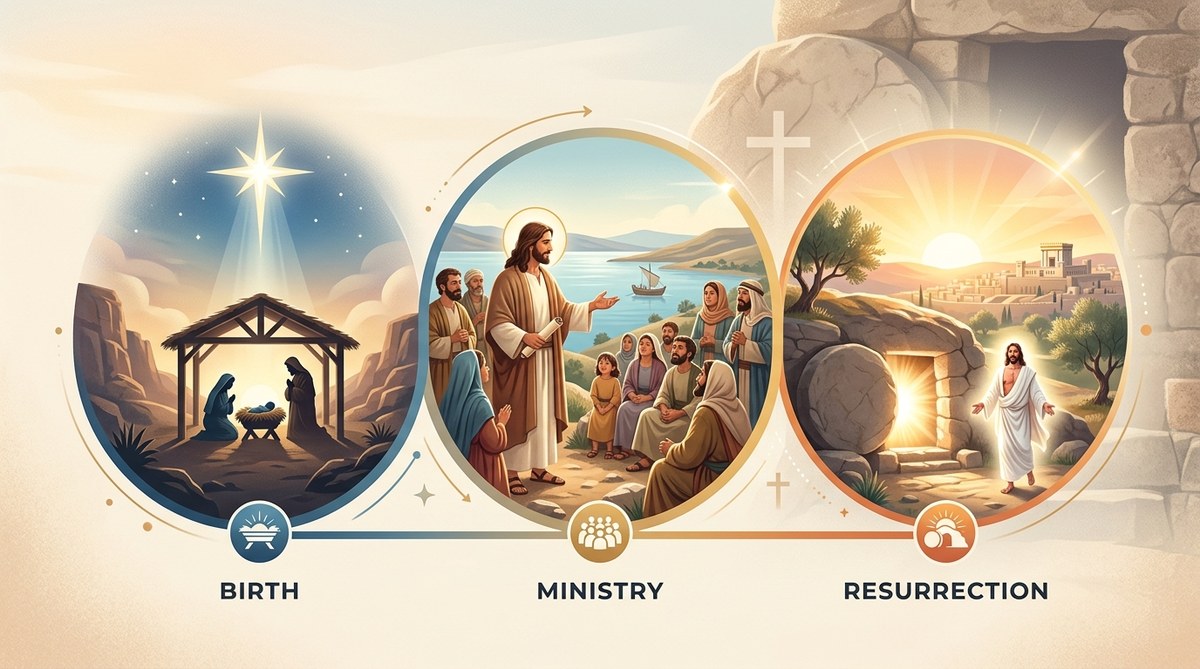
Every December, millions of people around the world sing carols about a baby in a manger. Every spring, millions more fill churches on Easter Sunday. But between that humble birth in Bethlehem and the empty tomb in Jerusalem, a remarkable story unfolds. For anyone wanting to understand the Bible better, seeing the life of Jesus timeline laid out clearly can turn scattered stories into one connected journey. This guide walks through the major moments of His life in simple order, from prophecy to resurrection. You will see how each event builds on the one before it. Whether you are teaching a class, leading a family devotion, or just exploring the Christian faith for yourself, this timeline will help you see the whole picture with fresh eyes.
The life of Jesus timeline follows a clear arc: His miraculous birth, His baptism and early ministry, three years of teaching and miracles, His crucifixion, and His resurrection on the third day. This overview helps you trace each major event in order, see how the Gospels connect, and understand why every step matters for the Christian faith.
When you open the Gospels, the story of Jesus can feel like a collection of beautiful moments without a clear order. You hear about His birth in Bethlehem, then suddenly He is teaching crowds, healing strangers, and walking on water. For many readers, the timeline feels scattered. That is because the Gospel writers arranged events for theological purposes, not like a modern biography. But when you lay the key moments side by side, a clear life of Jesus timeline emerges. It runs from a humble birth in a small town to a resurrection that changed the world. This guide walks through those major events in plain language, with the year, location, and significance of each stop along the way.
The life of Jesus timeline spans about 33 years, from His miraculous birth in Bethlehem to His resurrection in Jerusalem. His ministry lasted roughly three years, filled with teaching, healing, and miracles. The timeline is not just a list of dates. It is a story of God entering human history, calling people to faith, and offering salvation to everyone who believes.
Every year, millions of people open the Gospels and ask the same question: what happened, and in what order? The life of Jesus timeline is more than a list of dates. It is a story with a beginning, a middle, and a world changing ending. For anyone teaching a Sunday school class, preparing a Bible study, or simply exploring the faith, seeing the major events in order helps the whole picture come alive.
This guide walks through the life of Jesus in clear stages. You will see where each event fits, why it matters, and how it connects to the bigger story of the Bible. By the end, you will have a simple mental map of Jesus’ life, from before His birth to after His resurrection.
The life of Jesus timeline follows a clear path: His miraculous birth, early years, baptism, public ministry of teaching and healing, His death on the cross, and His resurrection. Understanding this sequence helps you see how each event connects to the bigger story of salvation and gives you a solid foundation for studying the Gospels with confidence.
## A Simple Roadmap Through the Gospels
The story of Jesus is the centerpiece of the Christian faith. For new believers and lifelong students alike, tracing His life from beginning to end brings the Bible to life. The Gospels of Matthew, Mark, Luke, and John each give a slightly different angle, but together they paint one complete portrait.
This life of Jesus timeline will walk you through the key moments in order. You will see how His birth, ministry, death, and resurrection fit into a single, connected story. No seminary degree required. Just an open heart and a willingness to learn.
—
## Where the Story Begins: Prophecy and Birth
The life of Jesus timeline does not start in a manger. It starts centuries earlier. The Old Testament contains hundreds of prophecies about the Messiah. Isaiah spoke of a child born to us, a son given to us (Isaiah 9:6). Micah named Bethlehem as His birthplace (Micah 5:2).
These promises found their fulfillment in a small town called Nazareth. An angel appeared to a young woman named Mary. She was a virgin, engaged to a carpenter named Joseph. The angel told her she would conceive a son by the Holy Spirit. She would name Him Jesus, because He would save His people from their sins.
Joseph was troubled at first. An angel appeared to him in a dream and confirmed the message. Joseph obeyed and took Mary as his wife. This is a powerful reminder that God often works through ordinary people in ordinary circumstances. If you are exploring what it means to follow Him, you might find it helpful to read about [what it really means to be born again](https://hkci.org.hk/what-does-it-really-mean-to-be-born-again/).
## The Birth of Jesus: A Humble Beginning
The Gospel of Luke gives the most detail about Jesus’ birth. Caesar Augustus issued a decree that all the Roman world should be registered. So Joseph and a pregnant Mary traveled from Nazareth to Bethlehem, the town of David. There was no room in the inn, so Jesus was born in a humble setting and laid in a manger.
Luke 2:8-14 records shepherds in the fields receiving an angelic announcement. They hurried to see the newborn Savior. Matthew 2 adds the visit of the Magi, wise men from the East who followed a star to worship the child and present gifts of gold, frankincense, and myrrh.
The exact date of Jesus’ birth is not given in Scripture. Most scholars place it between 6 and 4 BC, during the reign of Herod the Great. The year we use in our calendar (AD 1) was calculated centuries later by a monk named Dionysius Exiguus, and he made a small math error. That is why the timeline can feel a little off.
## The Hidden Years: Jesus’ Childhood and Early Life
The Gospels stay mostly silent about Jesus’ childhood. Only Luke gives us one story from those years. At age twelve, Jesus traveled with his parents to Jerusalem for Passover. There, he stayed behind in the temple, listening to teachers and asking questions. His parents found him after three days of searching (Luke 2:41-52).
That single story tells us something important. Even as a child, Jesus was aware of his identity and his Father’s work. After this event, the Bible jumps ahead. We know Jesus grew in wisdom and stature, and he lived in Nazareth with Mary and Joseph. But the details of those hidden years remain a mystery to us.
For a deeper look at the Gospels and how they weave together, you might enjoy this [guide to reading the Bible for the first time](https://hkci.org.hk/how-to-read-the-bible-for-the-first-time-a-beginners-roadmap/). It walks through the four Gospel accounts in a way that makes the story feel fresh.
## The Birth of Jesus: Prophecy and Fulfillment
The life of Jesus timeline begins centuries before his birth. Old Testament writers spoke of a coming Messiah. Isaiah wrote about a child born to us, a son given to us (Isaiah 9:6). Micah named Bethlehem as the birthplace (Micah 5:2). These promises shaped the hope of Israel for generations.
When the time came, a young woman named Mary received a stunning message. The angel Gabriel told her she would conceive by the Holy Spirit. Her fiancé Joseph also received a dream, reassuring him to take Mary as his wife. The Gospel of Luke records that Mary and Joseph traveled to Bethlehem for a Roman census. There was no room in the inn, so Jesus was born in a humble setting and laid in a manger. Shepherds nearby heard angels announce His birth. Later, wise men from the East followed a star to bring gifts of gold, frankincense, and myrrh.
Jesus’ life follows a clear arc: miraculous birth, baptism, a three year public ministry of teaching and healing, crucifixion, and resurrection. This timeline helps you see how the Gospels fit together, deepen your faith, and share the story with confidence. Use it for personal study, teaching, or family devotions.
## Why a Clear Timeline Matters
The Gospels are not arranged like a modern biography. Matthew, Mark, Luke, and John each tell the story of Jesus from a different angle. Sometimes the order of events differs. Sometimes details are added or left out. That can make the life of Jesus timeline feel confusing at first.
But when you step back, a clear picture emerges. Jesus’ life follows a powerful arc. It moves from humble birth to public ministry to sacrificial death and victorious resurrection. Understanding that arc helps you see the whole story, not just isolated verses.
This guide walks through the major events in order. You will learn what happened, when it likely happened, and why it matters. Whether you are teaching a class, leading a small group, or simply studying on your own, this timeline gives you a solid framework.
Jesus’ life follows a clear path: His miraculous birth, roughly thirty years of quiet preparation, a three-year public ministry of teaching and healing, His death on the cross, and His victorious resurrection. This timeline helps you see how each event connects to the bigger story of God’s plan for humanity and why it matters for your faith today.
## Why a Timeline of Jesus Helps Your Faith
Have you ever tried to piece together the life of Jesus from the Gospels and felt a little lost? You are not alone. The four Gospels, Matthew, Mark, Luke, and John, tell one story but from different angles. They were not written as modern biographies. They were written so you would believe. A clear timeline of Jesus’ life helps you see how the birth, ministry, and resurrection fit together into one beautiful story.
When you study the life of Jesus timeline, you begin to notice patterns. You see how each event prepared for the next. You understand why certain moments mattered so much. And you gain confidence in the historical reality of Jesus.
This guide walks through the major seasons of His life. You will see the birth, the years of preparation, the public ministry, the final week, and the resurrection. Each section includes Scripture references so you can follow along in your own Bible.
If you are new to the Gospels, this timeline also works as a study map. You can pair it with [How to Read the Bible for the First Time: A Beginner’s Roadmap](https://hkci.org.hk/how-to-read-the-bible-for-the-first-time-a-beginners-roadmap/) to get more context before you dive in.
## The Big Picture of Jesus’ Life
Jesus lived about 2,000 years ago in the region of Galilee and Judea, which today is part of Israel and Palestine. The main sources for His life are the four Gospels: Matthew, Mark, Luke, and John. Each one offers a slightly different angle, but together they tell one story.
His life follows a clear arc:
– Birth in Bethlehem
– Early years in Nazareth
– Baptism and temptation
– Public ministry of teaching and miracles
– Crucifixion in Jerusalem
– Resurrection on the third day
– Ascension into heaven
This timeline helps you see how the pieces fit together. It also gives you a simple map for personal study or for teaching others. If you are new to the Bible, start with [How to Read the Bible for the First Time: A Beginner’s Roadmap](https://hkci.org.hk/how-to-read-the-bible-for-the-first-time-a-beginners-roadmap/) to build a solid foundation before tracing the events of Jesus’ life.
## Before the Birth: Prophecy and Promise
The life of Jesus did not begin in Bethlehem. The Bible teaches that Jesus existed before creation, as the Word who was with God and was God (John 1:1). But the story we can trace in the Gospels starts with promises made centuries earlier. Old Testament writers like Isaiah and Micah pointed to a coming Messiah, a deliverer who would rescue God’s people. These prophecies matter because they frame everything Jesus did. He was not an accidental figure. His arrival was planned, promised, and prepared for over many generations.
If you want to explore this more, take a look at [7 Old Testament Prophecies That Point Directly to Jesus](https://hkci.org.hk/7-old-testament-prophecies-that-point-directly-to-jesus/) to see how the Hebrew Scriptures anticipated His coming.
## The Birth of Jesus: Prophecy Meets History
The life of Jesus timeline begins with a miracle. An angel appeared to Mary, a young woman in Nazareth, and told her she would conceive by the Holy Spirit. Joseph, her fiancé, planned to end the engagement quietly. But an angel spoke to him too, and he obeyed.
The Roman Emperor Caesar Augustus then issued a decree. Everyone had to return to their hometown for a census. Joseph was from Bethlehem, the city of David. So he traveled there with Mary, who was about to give birth.
There was no room in the inn. Jesus was born in a humble stable and laid in a manger. This fulfilled the Old Testament prophecy that the Messiah would be born in Bethlehem. If you want to see how deeply the prophets anticipated this moment, this guide to [7 Old Testament prophecies that point directly to Jesus](https://hkci.org.hk/7-old-testament-prophecies-that-point-directly-to-jesus/) is a great next step.
Shepherds visited Him after angels announced His birth. Later, wise men from the East followed a star to worship Him and brought gifts of gold, frankincense, and myrrh. These events are recorded in Matthew 1-2 and Luke 2.
## The Hidden Years and Early Life
The Gospels remain mostly silent about Jesus’ childhood. Luke gives us one glimpse. At age twelve, Jesus stayed behind in Jerusalem during Passover, and His parents found Him in the temple, listening and asking questions. Even at a young age, He was aware of His identity and mission. He told His worried parents, “Did you not know that I must be in My Father’s house?” (Luke 2:49).
After that, the Bible simply says He grew in wisdom and stature (Luke 2:52). This quiet period matters. It reminds us that Jesus lived an ordinary human life before His public ministry began. He learned, worked, and grew up in Nazareth. That ordinary season prepared Him for the extraordinary work ahead.
## The Baptism and Temptation: The Start of His Public Ministry
Jesus began His public work around age thirty. His cousin John the Baptist had been preaching in the wilderness, calling people to repent. Jesus came to the Jordan River to be baptized by John. This moment mattered. As Jesus came up from the water, heaven opened and the Holy Spirit descended on Him like a dove. A voice from heaven said, “This is my beloved Son, with whom I am well pleased” (Matthew 3:17).
Right after baptism, the Spirit led Jesus into the wilderness. There He fasted for forty days and nights. Satan tempted Him three times. Jesus answered each temptation with Scripture. He did not sin. This time of testing prepared Him for public ministry.
## The Early Ministry of Jesus
Jesus began His public work in Galilee, a region in northern Israel. He called ordinary people to follow Him. Fishermen like Peter, Andrew, James, and John left their nets. Matthew left his tax booth. These twelve men became His closest disciples.
His early ministry included a few key moments:
– Turning water into wine at a wedding in Cana (John 2:1-11)
– Clearing the temple in Jerusalem during Passover
– Meeting Nicodemus, a Pharisee, to explain spiritual rebirth
– Speaking with the Samaritan woman at the well
– Teaching large crowds across Galilee
Jesus did not stay in one place. He traveled through towns and villages, teaching in synagogues, healing the sick, and announcing the kingdom of God. His ministry lasted roughly three years, though the Gospels do not give exact dates.
## The Birth of Jesus
The life of Jesus timeline begins with a miracle. An angel told Mary she would give birth to a son, even though she was a virgin. Her fiancé Joseph also received a message in a dream. The child would be named Jesus, which means “The Lord saves.”
Mary and Joseph traveled to Bethlehem for a Roman census. There was no room in the inn, so Jesus was born in a humble setting and placed in a manger. Shepherds came to worship Him after angels announced His birth. Later, wise men from the East followed a star to bring gifts of gold, frankincense, and myrrh.
These events fulfilled Old Testament prophecies. The Messiah was born in Bethlehem, just as Micah 5:2 predicted. If you want to explore how ancient prophecies connect to Jesus, check out [7 Old Testament prophecies that point directly to Jesus](https://hkci.org.hk/7-old-testament-prophecies-that-point-directly-to-jesus/).
## Why a Timeline Helps Your Bible Study
A life of Jesus timeline gives you the big picture. Instead of jumping between Gospels, you see one continuous story. That makes it easier to spot patterns, understand His teachings, and follow His journey from cradle to cross to empty tomb.
Many people read the Bible in fragments. They know the Christmas story. They know the Easter story. But the middle years often feel fuzzy. A timeline fills that gap. It helps you see how each event connects to the next.
You do not need to be a scholar to benefit. If you are teaching a Sunday school class or reading the Gospels for the first time, a simple timeline gives you a mental map. You will know where each story fits.
If you are new to the Bible, start with our [beginner’s roadmap for reading the Bible](https://hkci.org.hk/how-to-read-the-bible-for-the-first-time-a-beginners-roadmap/) before you dive into the timeline below.
—
## The Big Picture: Why a Timeline Matters
The Gospels are not arranged like a modern biography. Matthew, Mark, Luke, and John each highlight different angles of Jesus’ life. They group teachings by topic rather than strict dates. That is why a timeline helps.
When you see the order of events, the story becomes clearer. You notice how John the Baptist prepared the way. You watch Jesus call ordinary fishermen. You follow Him through Galilee, then toward Jerusalem. The timeline also helps you connect the dots between prophecy and fulfillment. For a deeper look at how the Old Testament points to Jesus, explore [these prophecies that point directly to Jesus](https://hkci.org.hk/7-old-testament-prophecies-that-point-directly-to-jesus/).
The goal of this guide is simple. You will walk away with a clean, chronological map of Jesus’ life. You will know where the key moments fit, why they matter, and how to explain them to others.
## Why a Timeline of Jesus’ Life Matters
Reading the Gospels can feel like stepping into a busy marketplace. There are healings, parables, confrontations, and long teaching sessions. It is easy to lose track of where each event fits.
A life of Jesus timeline helps you see the big picture. It shows how His birth, ministry, death, and resurrection connect into one story. When you see the flow, the Bible starts to make more sense. You also understand why each event matters.
For parents and teachers, a simple timeline is a powerful tool. It helps you explain the Gospel to children and new believers in a way that is easy to follow. Instead of jumping around the Gospels, you can walk through His life in order. That makes the story stick.
If you are new to the Bible, start with a beginner friendly guide on [how to read the Bible for the first time](https://hkci.org.hk/how-to-read-the-bible-for-the-first-time-a-beginners-roadmap/) before diving into the timeline below.
## Why a Timeline of Jesus Helps You Read the Gospels
The Gospels are not arranged like a modern biography. Matthew, Mark, Luke, and John each tell the story of Jesus from a different angle. They group teachings by topic. They skip details that other writers include. That can make the order feel blurry.
A life of Jesus timeline helps you see the big picture. You can track where each event happened, who was present, and how one moment led to the next. This is especially helpful for new believers, Sunday school teachers, and parents explaining the story to children.
When you read the Gospels with a timeline in mind, you notice things you might otherwise miss. You see how Jesus’ early life prepared Him for ministry. You watch His popularity rise and fall. You understand why the religious leaders reacted the way they did. And you see how every step, from Bethlehem to the empty tomb, fits into a single divine plan.
Jesus’ life follows a clear timeline: His miraculous birth in Bethlehem, His baptism and teaching ministry across Galilee, His crucifixion in Jerusalem, and His resurrection on the third day. Each phase fulfills Old Testament prophecy and reveals His identity as the Son of God, sent to bring salvation to all who believe.
## Why the Timeline of Jesus Matters
The story of Jesus is not a vague legend. It is rooted in real history, real places, and real people. When you trace the life of Jesus timeline, you begin to see how every event connects. His birth prepared the way. His ministry revealed God’s heart. His death and resurrection changed everything.
For a parent teaching kids or a believer wanting deeper understanding, seeing the order of events helps. It makes the Gospel feel more grounded. It also helps you understand why certain moments mattered so much.
This article walks through the major seasons of Jesus’ life. You will find a clear timeline, key dates, and practical ways to study them. By the end, you will feel confident tracing the arc of His life from Bethlehem to the empty tomb.
## Why a Life of Jesus Timeline Matters
Many people read the Gospels as four separate stories. Matthew, Mark, Luke, and John each highlight different details. But when you line them up, they tell one continuous story.
A timeline helps you see the flow. You notice how Jesus moved from Galilee to Judea. You see how His teaching ministry built toward the cross. You understand why the religious leaders grew more hostile over time.
For parents and Sunday school teachers, a timeline also makes the story easier to tell. Children grasp sequence well. When you say “first Jesus was born, then He was baptized, then He taught, then He died and rose again,” the gospel becomes a clear story instead of a collection of random events.
This guide walks through the major moments of Jesus’ life in order. It is built for personal study, teaching, or simple curiosity. You do not need a theology degree to follow along. Just an open heart and maybe a Bible nearby.
The life of Jesus timeline flows through four major phases: His miraculous birth, His early years, His three-year public ministry of teaching and healing, and His death, resurrection, and ascension. Each phase builds on the previous one, showing how Jesus fulfilled Old Testament prophecy and launched the Christian faith. This overview helps you teach it clearly and remember it easily.
Write the body content here.
# The Life of Jesus: A Simple Timeline of His Birth, Ministry, and Resurrection
Every story has a starting point, and the story of Jesus begins in a way that still amazes people today. A young woman named Mary, a carpenter named Joseph, and a birth that changed the course of human history. But the life of Jesus is more than just a Christmas story. It is a timeline of purpose, teaching, miracles, sacrifice, and victory. Whether you are new to the Bible or have read it for years, seeing the major events in order can help you understand why Jesus came and what His life means for you today.
Jesus’ life follows a clear arc: miraculous birth, baptism, teaching and miracles, crucifixion, and resurrection. Each phase fulfilled Old Testament prophecy and revealed His identity as the Son of God. This timeline helps you trace those events in order, deepen your personal study, and see how every moment pointed toward the cross and the empty tomb.
## Why a Timeline of Jesus’ Life Matters
Reading the Gospels can feel like stepping into a busy market. There is so much happening. Miracles, parables, arguments, healing, teaching. It is easy to lose track of the order of events. A timeline helps you see the big picture.
When you understand the sequence of Jesus’ life, the stories come alive. You see how His birth set the stage for His ministry. You understand why His death and resurrection changed everything. And you gain a clearer view of the gospel message as a whole.
This guide walks through the major moments of Jesus’ life in simple order. You will see His birth, His ministry, His miracles, His death, and His resurrection. Each section connects the events to their meaning. By the end, you will have a working mental map of the life of Jesus timeline that you can use for personal study, teaching, or simply growing in faith.
If you are new to the Bible, this timeline is a friendly starting point. If you have been a Christian for years, it can help you see the big picture again. Either way, the goal is simple: to help you follow the story of Jesus from beginning to end.
—
## Why a Timeline of Jesus’ Life Matters
The Gospels are not arranged like a modern biography. Matthew, Mark, Luke, and John each highlight different moments. They group teachings and miracles by theme, not always by date. That is why a life of Jesus timeline helps so much.
When you see the order of events, the story comes alive. You notice how Jesus moved from teaching to healing to the cross. You see the flow from His birth to His ministry to His resurrection. The timeline also helps you understand the cultural and historical setting. That makes the Bible feel more real, not like a collection of isolated stories.
If you are teaching Sunday school or leading a small group, a clear timeline gives you a framework. You can guide others through the major moments without getting lost in the details. And if you are simply curious about who Jesus is, this overview will help you see the big picture of His life.
—
## Before the Birth: The Promise and the Prophecy
The life of Jesus timeline starts before His birth. Prophets in the Old Testament wrote about Him centuries in advance. Isaiah spoke of a child born to us, a son given to us, and called Him Wonderful Counselor, Mighty God, Everlasting Father, Prince of Peace (Isaiah 9:6). Micah predicted His birthplace in Bethlehem (Micah 5:2). These prophecies matter because they show that Jesus was not an accidental figure. His arrival was planned.
The New Testament opens with the announcement to Mary. The angel Gabriel told her she would conceive by the Holy Spirit. She was a virgin. This fulfilled the prophecy in Isaiah 7:14 about a virgin giving birth to Immanuel, which means God with us.
Joseph, her betrothed, also received a message from an angel. He was told not to be afraid to take Mary as his wife. This sets the stage for the birth narrative. If you want to explore why Christians see these events as the fulfillment of ancient promises, read about the [7 Old Testament prophecies that point directly to Jesus](https://hkci.org.hk/7-old-testament-prophecies-that-point-directly-to-jesus/).
## The Birth of Jesus: Setting the Stage
The story begins in Nazareth, a small town in Galilee. Mary, a young virgin, was engaged to Joseph, a carpenter. An angel named Gabriel appeared to Mary with stunning news. She would conceive a son through the Holy Spirit. His name would be Jesus, and He would save His people from their sins.
Joseph was troubled at first. But an angel spoke to him in a dream and told him not to be afraid. Joseph took Mary as his wife. This fulfilled the prophecy that the Messiah would be born of a virgin.
Around this time, Caesar Augustus ordered a census. Everyone had to return to their ancestral town to register. Joseph was from the line of David, so he traveled to Bethlehem with Mary. While they were there, Mary gave birth to Jesus in a humble setting, because no room was available in the inn. She wrapped Him in cloths and laid Him in a manger.
Luke 2:8-20 records that shepherds in nearby fields received an angelic announcement. They went to Bethlehem and found the newborn Savior. This is why the nativity story remains central to Christmas celebrations.
## What Do We Know About Jesus’ Early Life?
The Gospels give us only a few details about Jesus’ childhood. After the birth narrative, we see Him presented at the temple in Jerusalem. Simeon and Anna, two faithful Jews, recognized Him as the promised Messiah.
Later, wise men from the East visited Him in Bethlehem, bringing gifts of gold, frankincense, and myrrh. Warned in a dream, they did not return to King Herod. Joseph also received a warning, so he took Mary and Jesus to Egypt to escape Herod’s murderous plan. After Herod died, the family returned and settled in Nazareth.
The only childhood story we have comes from Luke 2. At age twelve, Jesus traveled with His parents to Jerusalem for Passover. There, He stayed behind in the temple, listening to teachers and asking questions. His parents found Him after three days. His response to them is telling: “Did you not know that I must be in My Father’s house?” (Luke 2:49). Even at twelve, Jesus understood His divine identity.
## Why a Timeline of Jesus’ Life Matters
A life of Jesus timeline helps you see the whole story. The Gospels are not arranged like a modern biography. Matthew, Mark, Luke, and John each highlight different themes and audiences. Putting the events in order helps you connect the dots between prophecy and fulfillment, between Jesus’ teaching and His mission.
When you see the timeline, patterns emerge. You notice how each miracle prepared the disciples for something harder. You see how each parable built on the one before it. And you begin to understand why Jesus said and did certain things at specific moments.
This guide walks through the major events of Jesus’ life, from His birth to His resurrection. It is designed for personal study, Sunday school teaching, or simply for your own faith enrichment. If you want to go deeper after reading, check out this [guide on how to read the Bible for the first time](https://hkci.org.hk/how-to-read-the-bible-for-the-first-time-a-beginners-roadmap/) to continue your journey.
## The Big Picture of Jesus’ Life
The life of Jesus timeline is not just a list of dates. It is a story that connects the Old Testament promises to the New Testament fulfillment. Every event, from His birth to His resurrection, fits into a larger plan. Understanding that plan helps you see why each moment matters.
The Gospels give us the main account. Matthew, Mark, Luke, and John each highlight different details. When you place those details side by side, a clear timeline emerges. It is not an exhaustive biography, but it gives us everything we need to know who Jesus is and why He came.
Below is a simple timeline of the life of Jesus. It moves from His birth through His ministry, death, and resurrection. You can use it for personal study, Sunday school lessons, or simply to refresh your own understanding.
## The Birth and Early Years
The story begins in Bethlehem. Mary and Joseph traveled there for a Roman census. Jesus was born in humble surroundings, not a palace. Shepherds visited Him after angels announced His birth. Later, Magi from the East followed a star to worship Him.
His early years were marked by obedience and growth. Luke 2:52 says Jesus grew in wisdom and stature. His family fled to Egypt to escape King Herod, then settled in Nazareth. At age twelve, He stayed behind in the temple courts, listening and asking questions. His parents found Him after three days. This event gives us the only glimpse of Jesus between His birth and His baptism.
## The Baptism and Temptation
Jesus began His public ministry around age thirty. His cousin John the Baptist prepared the way, calling people to repent. Jesus came to the Jordan River to be baptized, not because He needed repentance, but to identify with humanity and to fulfill all righteousness.
At His baptism, the heavens opened and the Holy Spirit descended on Him like a dove. A voice from heaven said, “This is my beloved Son, with whom I am well pleased” (Matthew 3:17). This moment marked the start of His public ministry.
Right after that, the Spirit led Jesus into the wilderness. There He fasted for forty days and was tempted by Satan. Jesus answered every temptation with Scripture. He came out victorious and ready to teach.
## The Early Ministry and Calling of the First Disciples
Jesus began His ministry in Galilee, roughly around the age of thirty. His first recorded miracle happened at a wedding in Cana, where He turned water into wine. That act revealed His divine power to His disciples.
Soon after, Jesus began calling people to follow Him. He chose twelve ordinary men: fishermen, a tax collector, and others. These disciples would become His closest companions and the foundation of the early church.
His teaching style was unique. He used parables, short stories with deep spiritual meaning, to explain the Kingdom of God. If you have ever wondered why He taught this way, you can explore [why Jesus used parables instead of plain language](https://hkci.org.hk/why-did-jesus-speak-in-parables-instead-of-plain-language/) to understand the purpose behind that approach.
## The Birth of Jesus: Prophecy and Fulfillment
Jesus was born in Bethlehem, a small town in Judea. The Gospels of Matthew and Luke give the most detail. Mary and Joseph traveled to Bethlehem for a census, and Jesus was born in a humble setting because there was no room in the inn. Shepherds visited Him after angels announced His birth, and later wise men from the East brought gifts of gold, frankincense, and myrrh.
His birth was no accident. It fulfilled Old Testament prophecy, including the promise that a Messiah would be born in Bethlehem. For a deeper look at how the Hebrew Scriptures pointed to Jesus, explore [7 Old Testament prophecies that point directly to Jesus](https://hkci.org.hk/7-old-testament-prophecies-that-point-directly-to-jesus/).
## Early Life and Baptism
The Gospels tell us little about Jesus’ childhood. Luke gives one memorable glimpse. At age twelve, Jesus stayed behind in the temple courts, listening and asking questions among the teachers (Luke 2:41-52). His parents found Him after three days. Even then, He knew His Father’s business.
Jesus grew up in Nazareth. He worked as a carpenter, like Joseph. Then around age thirty, His public ministry began with baptism by John the Baptist in the Jordan River. This moment marked the start of His mission. At His baptism, the heavens opened and the Spirit descended like a dove. A voice from heaven said, “This is my beloved Son, with whom I am well pleased” (Matthew 3:17).
Right after baptism, Jesus spent forty days in the wilderness fasting and facing temptation from Satan. He emerged ready to teach, heal, and announce the kingdom of God.
## The Early Ministry Years
Jesus began His ministry in Galilee. He called ordinary people to follow Him. Fishermen like Peter, Andrew, James, and John left their nets and became His disciples. He traveled through towns and villages, teaching in synagogues and healing the sick.
His ministry had three clear phases:
– **Early Galilean period:** Miracles, teaching, and the calling of the first disciples
– **Later Galilean period:** Parables, the Sermon on the Mount, and growing opposition from religious leaders
– **Final Judean and Perean period:** Teaching on the way to Jerusalem, leading to His final week
During this time, Jesus performed miracles that pointed to His divine identity. He turned water into wine at Cana, healed the sick, gave sight to the blind, and even raised the dead. These signs were not just wonders. They revealed who He was and what His kingdom looked like.
## Why a Clear Timeline Matters
Many readers find the Gospels challenging because they weave together stories, teachings, and miracles without a strict date stamp. The Gospel of John even says that Jesus did many other things not written down. So a timeline helps you see the flow of His life. It connects the dots between the prophecy of His birth and the promise of His return.
When you study the life of Jesus in order, patterns emerge. You see how His early life prepared Him for ministry. You notice how each teaching built on the one before it. And you understand why the religious leaders felt threatened by Him.
A simple timeline also helps parents and teachers. It gives you a structure to share with kids or new believers. You can walk through the story with confidence, knowing the order of events matches the Gospel accounts.
## Why a Timeline of Jesus’ Life Matters
The Gospels are not arranged like a modern biography. Matthew, Mark, Luke, and John each highlight different themes. They arrange events for a purpose. So a timeline helps you see the whole story at a glance.
When you trace the life of Jesus timeline from beginning to end, patterns emerge. You see how the prophecies of the Old Testament connect to the events of the New Testament. You notice how each stage of His life prepared for the next. The birth points to the ministry. The ministry points to the cross. The resurrection changes everything.
If you are new to Bible study, this overview can be your starting point. If you have been a believer for years, it can help you see the big picture more clearly. For help getting into the text itself, this [beginner’s roadmap for reading the Bible](https://hkci.org.hk/how-to-read-the-bible-for-the-first-time-a-beginners-roadmap/) is a helpful next step.
## Before the Birth: The Promised Messiah
The story of Jesus did not begin in Bethlehem. It began centuries earlier with promises and prophecies. The Old Testament points forward to a coming Messiah who would rescue God’s people. For those exploring the faith, this background matters. It shows Jesus did not appear by accident. He arrived exactly as God had planned.
The Gospels of Matthew and Luke give us the birth accounts. They tell of Mary, a young woman in Nazareth, and Joseph, her betrothed. An angel announced Jesus would be born of the Holy Spirit. Mary was a virgin, which fulfilled the prophecy in Isaiah 7:14. This is one of many [7 Old Testament prophecies that point directly to Jesus](https://hkci.org.hk/7-old-testament-prophecies-that-point-directly-to-jesus/).
## The Birth of Jesus
Jesus was born in Bethlehem, a small town in Judea. Caesar Augustus had ordered a census, so Joseph and Mary traveled to Joseph’s ancestral town. There was no room in the inn, so Jesus was placed in a manger. Shepherds in nearby fields received angelic announcements and came to worship Him. Later, wise men from the East followed a star to bring gifts of gold, frankincense, and myrrh.
The birth narrative appears in Matthew and Luke. Both accounts agree on the essentials: a virgin birth, a Bethlehem setting, and a divine mission. The exact date is not given in Scripture. Most scholars place His birth between 6 and 4 BC, based on historical records of Herod the Great. Christmas on December 25 is a tradition, not a biblical date. What matters most is the meaning: God entered human history in the person of Jesus Christ.
## Why a Timeline of Jesus’ Life Matters
Understanding the life of Jesus timeline helps you see the whole story. The Gospels present four portraits of Jesus. Each one highlights different details. But when you lay the events side by side, a clear sequence emerges. That sequence helps you connect His birth, teaching, miracles, death, and resurrection into one continuous story.
For new believers, this timeline builds a mental map. For parents and Sunday school teachers, it gives you a simple structure to pass on. For curious seekers, it shows that Jesus was a real person who lived in a real time and place.
### A Note on Dates
Scholars do not know the exact dates of every event. Most place Jesus’ birth around 4 to 6 BC, even though our calendar starts at year 1 AD. That sounds odd, but it comes from a miscalculation made centuries ago. The timeline below uses approximate dates that most historians and Bible teachers accept.
—
## Before the Birth: The Promise and the Announcement
The story of Jesus did not begin in Bethlehem. It began with prophecy. The Old Testament contains hundreds of predictions about a coming Messiah. Passages written centuries before Jesus was born point to His birthplace, His lineage, and His mission. For a deeper look, see these [7 Old Testament prophecies that point directly to Jesus](https://hkci.org.hk/7-old-testament-prophecies-that-point-directly-to-jesus/).
Then, in the fullness of time, an angel appeared to a young woman named Mary. Gabriel told her she would conceive a son by the Holy Spirit. She would call Him Jesus, and He would be called the Son of the Most High. Mary responded with faith, even though the news was overwhelming.
Joseph, her fiancé, also received a visit from an angel. He learned that Mary’s child was from the Holy Spirit. Joseph took Mary as his wife and prepared to raise the child as his own. This sets the stage for the birth narrative.
## The Birth of Jesus in Bethlehem
Luke 2 records the familiar scene. Caesar Augustus issued a decree that all the world should be taxed. So Joseph traveled with Mary from Nazareth to Bethlehem, the town of David, because Joseph was of the house and line of David.
While they were there, Mary gave birth to her firstborn son. She wrapped Him in swaddling cloths and laid Him in a manger, because there was no room in the inn.
That night, shepherds in nearby fields received an angelic announcement. They hurried to Bethlehem and found the baby just as the angel had said. This event is the centerpiece of the Christmas story and the starting point for any life of Jesus timeline.
## The Early Years: From Bethlehem to Nazareth
After the birth, the timeline moves quickly. Wise men from the East visited the child, bringing gifts of gold, frankincense, and myrrh. Warned in a dream, they avoided King Herod and returned home by another route.
Joseph also received a warning. He took Mary and Jesus to Egypt to escape Herod’s order. After Herod died, the family returned and settled in Nazareth of Galilee. Matthew 2:23 says this fulfilled what the prophets had spoken: “He will be called a Nazarene.”
The Gospels remain mostly silent about Jesus’ childhood. Luke gives one meaningful glimpse. At age twelve, Jesus traveled with his parents to Jerusalem for Passover. There, he stayed behind in the temple, listening to teachers and asking questions. His parents found him after three days, and he responded with words that hinted at his divine mission: “Did you not know that I must be in my Father’s house?” (Luke 2:49).
That single story bridges the gap between His birth and His public ministry. It shows His awareness of God as His Father even as a boy.
## The Baptism and Temptation: The Start of Public Ministry
Jesus began His public work around the age of thirty. His cousin John the Baptist prepared the way by calling people to repentance. Jesus came to the Jordan River to be baptized, not because He needed forgiveness, but to identify with humanity and to launch His mission.
At His baptism, the heavens opened. The Holy Spirit descended like a dove. A voice from heaven said, “This is my beloved Son, with whom I am well pleased” (Matthew 3:17). That moment marked the beginning of His public ministry.
Immediately after, Jesus went into the wilderness for forty days of fasting and prayer. There He faced temptation from Satan. He responded with Scripture each time. This event is important because it shows His dependence on the Father and His readiness for the work ahead.
## A Year of Popularity and Teaching
Jesus began His ministry in Galilee around age 30. He called ordinary people to follow Him. Fishermen, tax collectors, and everyday workers became His disciples.
His early ministry featured three key activities:
– Teaching in synagogues and on hillsides
– Healing the sick and restoring broken lives
– Casting out demons and confronting spiritual darkness
Crowds gathered wherever He went. His teaching carried authority that surprised the religious leaders. He spoke about the Kingdom of God, repentance, and the heart of the law rather than mere rule keeping.
During this period, Jesus performed His first miracle at a wedding in Cana, turning water into wine. He also called His first disciples, including Peter, Andrew, James, and John. This season of ministry is often called the Galilean period because most of it happened around the Sea of Galilee.
## A Simple Timeline of Jesus’ Life
The life of Jesus timeline can feel overwhelming at first. The Gospels weave together narrative, teaching, and miracle accounts. But when you lay the major events side by side, a clear sequence emerges. Here is a simple overview that works well for personal study, Sunday school lessons, or family devotions.
### Before the Birth: Prophecy and Promise
The story begins long before Bethlehem. Old Testament writers spoke of a coming Messiah. Isaiah promised a child born to us, a son given to us (Isaiah 9:6). Micah named Bethlehem as the birthplace (Micah 5:2). These promises shaped the hope of Israel for centuries. For a deeper look at these predictions, explore [7 Old Testament prophecies that point directly to Jesus](https://hkci.org.hk/7-old-testament-prophecies-that-point-directly-to-jesus/).
### The Annunciation and Birth of Jesus
The Gospel of Luke tells the story of the angel Gabriel visiting Mary. He told her she would conceive a son by the Holy Spirit. Mary responded with faith, even though she was a virgin. Joseph, her betrothed, also received a visit from an angel. He was told not to fear taking Mary as his wife because the child was from the Holy Spirit.
Jesus was born in Bethlehem, just as the prophet Micah had predicted centuries earlier (Micah 5:2). His birth was humble. He was laid in a manger because there was no room in the inn. Shepherds came to worship Him after angels announced His birth. Later, wise men from the East followed a star to bring gifts of gold, frankincense, and myrrh.
## The Early Years and Baptism
The Gospels tell us little about Jesus’ childhood. Luke shares one story of Jesus at age twelve, teaching in the temple courts. After that, the Bible stays silent until His public ministry begins.
At around age thirty, Jesus went to the Jordan River to be baptized by John the Baptist. This moment mattered deeply. As Jesus came up from the water, the heavens opened and the Holy Spirit descended on Him like a dove. A voice from heaven said, “This is my Son, whom I love; with him I am well pleased” (Matthew 3:17). This public declaration marked the start of His ministry.
Before teaching, Jesus spent forty days in the wilderness, fasting and facing temptation. He overcame every test using Scripture. Then He returned to Galilee and began preaching a simple message: repent, because the kingdom of heaven is near.
## The Early Ministry Years
Jesus began His public ministry around age thirty. He called twelve disciples, ordinary men like fishermen and tax collectors, to travel with Him. He taught in synagogues, healed the sick, and spoke with an authority that surprised religious leaders.
His teaching style was distinctive. He used parables, short stories with deep meaning, to explain the kingdom of God. If you want to explore why He taught this way, this [guide on why Jesus spoke in parables](https://hkci.org.hk/why-did-jesus-speak-in-parables-instead-of-plain-language/) offers helpful context.
During this period, Jesus performed many miracles. He turned water into wine, healed the blind, calmed storms, and raised the dead. These signs pointed to His divine identity and met real human needs. They were not magic tricks. They were windows into the heart of God.
## The Birth of Jesus: Prophecy Fulfilled
Jesus was born in Bethlehem, a small town with a big story. The Gospels of Matthew and Luke give the details. Mary, a young virgin, received news from an angel that she would conceive by the Holy Spirit. Her fiancé Joseph also received divine guidance in a dream and chose to stay by her side.
The birth itself was humble. Jesus was laid in a manger because there was no room in the inn. Shepherds visited him after angels announced his birth. Later, wise men from the East followed a star to bring gifts of gold, frankincense, and myrrh.
This wasn’t an accident. It was a fulfillment of Old Testament prophecy. If you want to see how deeply the Hebrew Scriptures point to Jesus, this resource on [7 Old Testament prophecies that point directly to Jesus](https://hkci.org.hk/7-old-testament-prophecies-that-point-directly-to-jesus/) walks through the most powerful examples.
—
## Why a Timeline of Jesus’ Life Matters
A timeline helps you see the flow of the story. When you read the Gospels, events can feel scattered across four different books. Matthew, Mark, Luke, and John each highlight different moments. Putting them side by side gives you a clearer picture of Jesus’ life, His teaching, and His mission.
The timeline also helps you connect the dots between Old Testament promises and their fulfillment in the New Testament. Jesus did not appear in a vacuum. His birth, ministry, and resurrection fulfilled hundreds of prophecies. Understanding the sequence makes those connections easier to see.
For a deeper look at how Jesus fulfilled ancient promises, explore these [7 Old Testament prophecies that point directly to Jesus](https://hkci.org.hk/7-old-testament-prophecies-that-point-directly-to-jesus/).
## Why a Timeline of Jesus’ Life Matters
Many readers open the Gospels and feel lost. Matthew, Mark, Luke, and John each tell the story from a different angle. They include different details. They arrange events in different ways. A timeline helps you see the whole picture.
When you study the life of Jesus in order, patterns emerge. You notice how his early years prepared him for ministry. You see how his teachings built on one another. You understand why the religious leaders reacted the way they did. And you grasp the significance of his death and resurrection in a deeper way.
This timeline is not meant to be an exhaustive academic study. It is a simple map. You can use it for personal reading, family devotions, or Sunday school lessons. It will help you place the key moments of Jesus’ life in order.
—
Jesus’ life follows a clear arc: a miraculous birth, a short but powerful ministry, a sacrificial death, and a victorious resurrection. This timeline walks through those major events in order, helping you see how the Gospels fit together. Whether you are new to the Bible or teaching others, this simple overview makes the story easy to follow and share.
## Why a Clear Timeline of Jesus’ Life Matters
The Gospels tell one story from four perspectives. Matthew, Mark, Luke, and John each highlight different details. When you lay the events side by side, a beautiful picture emerges. Jesus was not a myth or a legend. He was a real person who lived at a specific time in history. His birth, ministry, death, and resurrection changed the world forever.
For many readers, the Gospels can feel like separate snapshots. A timeline pulls the snapshots together into a single film. It helps you see how each event connects to the next. It also gives you a stronger foundation for studying deeper topics like [what it means to be born again](https://hkci.org.hk/what-does-it-really-mean-to-be-born-again/) or the [core beliefs every Christian should understand](https://hkci.org.hk/5-core-beliefs-every-christian-should-understand/).
This guide walks through the life of Jesus in chronological order. You will see His birth, His ministry, His miracles, His death, and His resurrection as one continuous story. Along the way, you will find practical tools to help you teach these events to others or simply understand them more deeply yourself.
The life of Jesus timeline moves through five major phases: His miraculous birth, early years, baptism and temptation, a three year public ministry of teaching and healing, and His death and resurrection. Each phase connects to Old Testament prophecy and reveals His identity as the Son of God. This timeline helps you study the Gospels with clarity, teach others with confidence, and see how every event points toward the cross and the empty tomb.
## Why a Clear Timeline Matters
The Gospels do not always arrange events in the same order. Matthew, Mark, Luke, and John each highlight different details. That can make the life of Jesus feel like a puzzle. A simple timeline helps you see the big picture. It shows how His birth, ministry, and resurrection fit together as one story.
When you track the life of Jesus timeline, patterns emerge. You notice how His teachings connect to His miracles. You see how His relationships with the disciples deepen over time. You understand why the religious leaders reacted the way they did. The timeline turns scattered stories into a single, powerful narrative.
This guide walks through the major seasons of His life. You will get clear dates, key events, and practical ways to remember them. Whether you are preparing a Sunday school lesson or reading the Gospels for yourself, this overview will help.
## Why a Timeline of Jesus’ Life Matters
Many people read the Gospels as isolated stories. But Jesus’ life was a connected journey. Each event builds on the one before it.
A timeline helps you see the flow. You notice how His baptism leads to His ministry. His teaching leads to conflict. His death leads to the resurrection. When you see the whole story, the details make more sense.
The Gospels are not arranged like a modern biography. Matthew, Mark, Luke, and John each emphasize different themes. They sometimes group events by topic instead of strict chronology. That is why a timeline is so helpful. It pulls the pieces together into one clear sequence.
If you want a deeper look at how the Gospels work together, our [beginner’s roadmap for reading the Bible](https://hkci.org.hk/how-to-read-the-bible-for-the-first-time-a-beginners-roadmap/) is a helpful next step.
Jesus’ life follows a clear arc: His miraculous birth, His baptism and temptation, three years of teaching and miracles, His crucifixion, and His resurrection. This timeline helps you see how each event connects to the bigger story of God’s plan. Use it for personal study, teaching, or simply to understand the Gospels with fresh eyes.
## Why a Life of Jesus Timeline Matters
The Gospels give us four portraits of Jesus. Each one highlights different details. Together, they tell one story. A timeline helps you see how the pieces fit. You can follow His steps from Bethlehem to the empty tomb without getting lost.
For parents and teachers, a clear timeline is a gift. It turns Bible stories into a connected journey. Kids remember a sequence far better than a collection of isolated events. And when you see the flow of Jesus’ life, the Gospels make more sense.
This guide walks through the major events in order. You will find dates where scholars agree, plus context that brings each moment to life. By the end, you will have a simple mental map of the life of Jesus timeline, from prophecy to resurrection.
## Why a Timeline of Jesus’ Life Matters
The Gospels are not arranged like a modern biography. Matthew, Mark, Luke, and John each tell the story from a different angle. They group teachings by theme, not always by date. That is why a timeline helps.
When you see the order of events, patterns emerge. You notice how Jesus prepared for ministry. You see how His teaching built on itself. You understand why the religious leaders reacted the way they did. And you grasp the weight of the final week, from the Triumphal Entry to the empty tomb.
For new believers, this overview makes the Gospel accounts feel more connected. For parents and teachers, it gives a simple framework to share with children or Bible study groups. If you are just beginning your faith journey, you might also want to read [what it really means to be born again](https://hkci.org.hk/what-does-it-really-mean-to-be-born-again/) to see how Jesus’ story connects to personal faith.
## The Big Picture Before the Timeline
Before we trace the events, it helps to see the whole story in one glance. Jesus’ life follows a clear arc: His eternal existence, His miraculous birth, His public ministry, His death, and His resurrection. Each phase builds on the one before it. The Gospels of Matthew, Mark, Luke, and John give us the details. Together, they paint one complete portrait.
This timeline is not just a list of dates. It is a map of God’s plan. Every event, from the angel’s announcement to Mary to the empty tomb, points to one central truth: Jesus came to seek and save the lost. If you are new to the Bible, this overview will help you see how the pieces fit together. If you have studied for years, it can refresh your mental picture of His journey.
Below is a simple, chronological guide through the major moments of Jesus’ life. You can use it for personal reading, teaching a class, or sharing the story with someone new to the faith.
The life of Jesus timeline moves through four major phases: His miraculous birth, His early years, His three-year public ministry, and His death and resurrection. Each phase reveals a different part of His identity and mission. Understanding this timeline helps readers see how the Gospels fit together, strengthens personal faith, and makes teaching the story of Jesus easier for parents and Bible students alike.
## Why a Clear Timeline Matters
Reading the Gospels can feel like stepping into a busy market. Names, places, and events blur together. A timeline helps you see the order of things. It turns scattered stories into one connected story.
Jesus did not appear out of nowhere. His birth fulfilled ancient promises. His ministry built on the work of John the Baptist. His death and resurrection changed history. When you see the sequence, the Gospels make more sense.
This guide walks through the major moments of His life in a simple order. You will learn the key events, the people involved, and why each part matters for the Christian faith. Whether you are teaching a class, preparing a lesson, or just curious, this timeline gives you a clear map of Jesus’ life.
—
## Why a Timeline of Jesus’ Life Matters
Many readers open the Gospels and feel lost. The four accounts of Matthew, Mark, Luke, and John are not arranged like a modern biography. They group stories by theme. They skip years at a time. They assume you already know the geography and the culture.
A timeline helps you see the whole story. It connects the birth in Bethlehem to the empty tomb. It shows how Jesus’ ministry built toward one clear purpose. When you see the order of events, the Gospels become easier to follow and richer to study.
If you are new to the Bible, this overview works like a map. You can read the Gospel accounts with a stronger sense of where each event fits. For parents and Sunday school teachers, this timeline gives you a simple framework to share with kids or new believers.
—
## The Big Picture: Why a Timeline Matters
The Gospels are not arranged like a modern biography. Matthew, Mark, Luke, and John each highlight different themes and arrange stories for a purpose. That is why a life of Jesus timeline helps. It puts the pieces in order.
When you see the flow from birth to resurrection, the story becomes clearer. You notice patterns. You see how each event builds on the one before it. You understand why the religious leaders grew threatened, why the disciples struggled, and why the cross was necessary.
The timeline below follows the Gospel accounts and the most commonly accepted chronology used by Bible scholars. It is not meant to settle every debate about exact dates. Instead, it gives you a practical map for personal study or Sunday school teaching.
## Before the Birth: Prophecy and Promise
The life of Jesus did not begin in Bethlehem. It began in eternity. The Gospel of John opens with a stunning claim: the Word existed before creation and was with God. For Christians, this points to Jesus being fully divine from the very beginning.
The Old Testament prepared the way. Prophets like Isaiah spoke of a coming Messiah hundreds of years before Jesus was born. These promises gave the Jewish people hope that God would send a deliverer. If you want to trace these connections, this guide on [7 Old Testament prophecies that point directly to Jesus](https://hkci.org.hk/7-old-testament-prophecies-that-point-directly-to-jesus/) is a great place to start.
## The Birth of Jesus: Promises Fulfilled
The story begins in Bethlehem, a small town with a huge destiny. Mary, a young virgin, received news from the angel Gabriel that she would give birth to the Son of God. Her fiancé Joseph also received angelic guidance and chose to stay by her side.
A Roman census required Joseph to travel with Mary to his ancestral town. There was no room in the inn, so Jesus was born in a humble stable and laid in a manger. Shepherds visited after angels announced His birth. Later, wise men from the East followed a star and brought gifts of gold, frankincense, and myrrh. These events fulfilled Old Testament prophecies about the Messiah’s birthplace in Bethlehem.
## The Early Years and Baptism
The Gospels stay mostly silent about Jesus’ childhood. Luke gives us one glimpse: at age twelve, Jesus stayed behind in the temple courts, listening and asking questions among the teachers (Luke 2:41-52). This moment shows His awareness of God’s mission even as a young person.
Then the timeline jumps ahead about eighteen years. Jesus grew up in Nazareth, a small town in Galilee, and worked as a carpenter. When He was about thirty years old, His cousin John the Baptist began preparing the way. John called people to repent and be baptized. Jesus came to the Jordan River and asked John to baptize Him.
Why did Jesus get baptized if He never sinned? This is a common question. Jesus said it was to “fulfill all righteousness” (Matthew 3:15). His baptism marked the beginning of His public ministry. At that moment, the heavens