
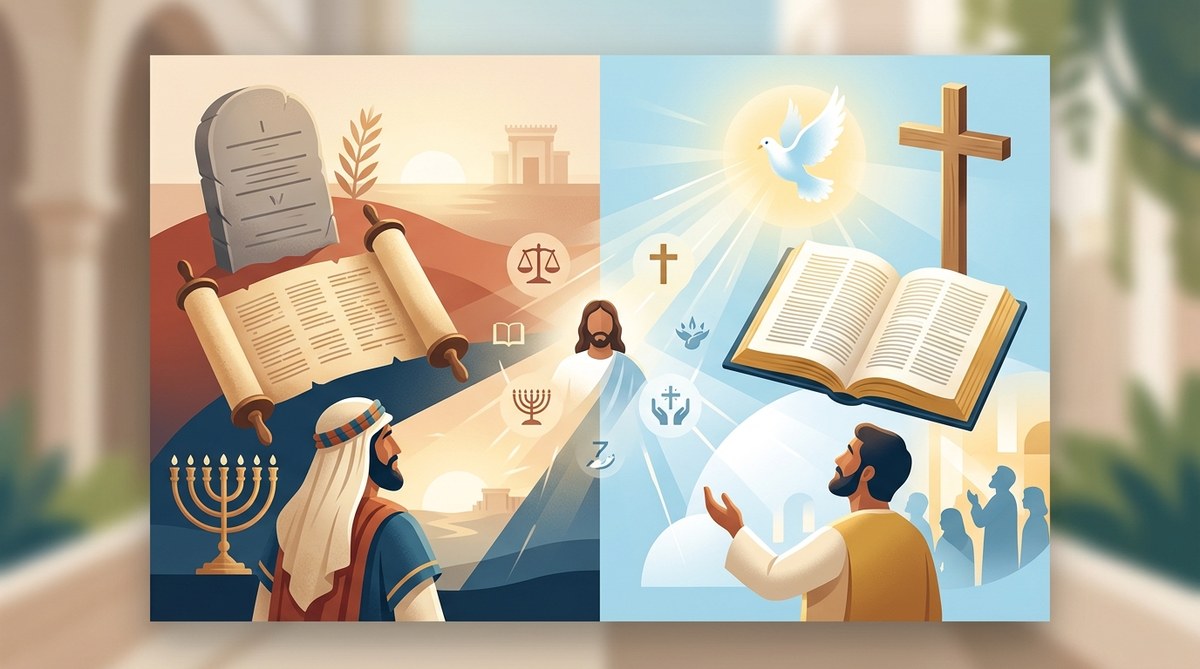
If you have opened a Bible for the first time, you might have noticed it feels like two different books. The first part, the Old Testament, is filled with ancient laws, epic battles, and poetic wisdom. The second part, the New Testament, focuses on the life of Jesus and the birth of the early church. This shift can be confusing. Why does God seem so different in each section? Why do the rules change? Understanding the old testament vs new testament differences is one of the most important steps for any new Christian. It helps you see the whole story of the Bible, not just the parts that seem hard to understand.
The Old Testament establishes God’s covenant with Israel through law, prophecy, and a focus on one nation. The New Testament fulfills that covenant through Jesus, offering grace to all people. The Old Testament asks, “How do we stay holy?” The New Testament asks, “How do we live in love?” Both are essential for a complete Christian faith.
The Covenant Changes from Nation to Individual
The most significant difference between the two testaments is the type of covenant God makes with his people. In the Old Testament, God forms a covenant with the nation of Israel. He gives them the Ten Commandments, the laws of Leviticus, and the promise of a land. This covenant is conditional. If Israel obeys, they receive blessings. If they disobey, they face consequences like exile or defeat.
In the New Testament, the covenant shifts. God makes a new covenant with all of humanity through Jesus Christ. This covenant is not based on national identity or following a complex set of laws. It is based on faith in Jesus and the grace he offers. The apostle Paul explains this in his letters. He says that the old law was a teacher, but the new covenant is a gift. You do not earn it. You receive it.
This change is like moving from a strict classroom where every rule is spelled out to a family relationship built on trust and love. The Old Testament says, “Do this to be my people.” The New Testament says, “You are my people, so live in love.”
The Focus Shifts from Law to Grace
If you read the first five books of the Bible, you will find hundreds of specific rules. There are rules about what to eat, what to wear, and how to worship. These laws were designed to set Israel apart from other nations. They created a holy community.
The New Testament does not throw away the law completely. Jesus says he came to fulfill the law, not to destroy it. But the focus moves from external rules to internal transformation. The apostle Paul argues that the law cannot save anyone. Only grace can. This is one of the most important old testament vs new testament differences to grasp.
In the Old Testament, sin is often dealt with through sacrifice and ritual cleansing. In the New Testament, sin is dealt with through confession and forgiveness. Jesus tells the story of the prodigal son, a young man who wastes his inheritance. When he returns home, his father does not punish him. He welcomes him back with open arms. That is the spirit of the New Testament. Grace is the dominant theme.
God’s Character Appears More Personal
Many beginners struggle with the way God acts in the Old Testament. He seems angry, jealous, and even violent. He orders the destruction of entire cities. He punishes entire nations for the sins of their kings. This can feel unsettling.
In the New Testament, God appears as a loving Father. Jesus shows us a God who prays for his enemies, heals the sick, and forgives those who hurt him. This is not a contradiction. It is a progression. The Old Testament reveals God as a king and a judge. The New Testament reveals him as a father and a friend.
Think of it like a parent raising a child. When the child is young, the parent sets firm boundaries and enforces consequences. As the child grows, the parent shifts to guidance and encouragement. God does the same with his people. The Old Testament was the childhood of humanity. The New Testament is the adulthood.
The Role of the Nation of Israel
The Old Testament is the story of one nation: Israel. Almost every book, from Genesis to Malachi, is about the people of Israel, their kings, their prophets, and their relationship with God. The land of Israel is central to the story.
The New Testament opens the story to the entire world. Jesus tells his disciples to go into all nations. The apostle Paul travels across the Roman Empire, planting churches in places like Philippi, Corinth, and Rome. The focus is no longer on a single geographic location. It is on a global community of believers.
This shift is why Christians do not follow the civil laws of ancient Israel. Those laws were for a specific nation at a specific time. The moral teachings of the New Testament, like loving your neighbor and forgiving your enemies, are for everyone, everywhere.
The Prophetic Voice Changes
Prophets like Isaiah, Jeremiah, and Ezekiel played a huge role in the Old Testament. They spoke for God, warning the people about their sins and predicting future events. Their messages were often harsh and direct.
In the New Testament, the prophetic voice is still present, but it changes form. John the Baptist is the last of the Old Testament style prophets. After him, the apostles take on a teaching role rather than a warning role. They explain the meaning of Jesus’ life and death. They encourage the early churches to stay faithful.
The book of Revelation, the last book of the New Testament, does contain prophecy. But it is written in a symbolic style that is very different from the straightforward warnings of an Old Testament prophet. The focus shifts from predicting doom to offering hope for the final victory of good over evil.
The Understanding of Salvation Evolves
In the Old Testament, salvation often means physical deliverance. God saves Israel from Egypt, from Babylon, and from famine. It is about surviving as a nation. The idea of an afterlife is present, but it is not the main focus.
In the New Testament, salvation takes on a spiritual meaning. It is about being saved from sin and death. Jesus offers eternal life. Paul writes that salvation is a gift from God, received through faith in Christ. This is a major shift. The Old Testament looks forward to a coming Messiah who will save the nation. The New Testament announces that the Messiah has come and he saves every person who believes.
If you want to understand this more deeply, you can read about what it really means to be born again. That article explains how the New Testament redefines salvation as a personal transformation.
The Worship Style Transforms
Old Testament worship is centered on the temple. It involves animal sacrifices, specific prayers, and a priesthood that only certain people can join. Music and song are important, but they follow strict patterns.
New Testament worship is centered on the heart and the community. There is no temple. There is no animal sacrifice. Instead, believers gather in homes or simple church buildings. They sing hymns, read scripture, and share a meal called communion. The focus is on participation, not performance.
This change is why modern Christian services look so different from what you read in the Old Testament. You will not find a priest sacrificing a lamb on Sunday morning. You will find a congregation singing together and listening to a sermon.
A Simple Comparison Table
| Topic | Old Testament | New Testament |
|---|---|---|
| Covenant | National (Israel) | Universal (all people) |
| Law | Detailed rules (613 commandments) | Grace and love |
| God’s Image | King and Judge | Father and Friend |
| Focus | One nation | The whole world |
| Salvation | Physical deliverance | Spiritual rebirth |
| Worship | Temple and sacrifice | Community and communion |
How to Read Both Testaments Together
Many beginners make the mistake of reading the Old Testament as a history book and the New Testament as a rule book. Neither approach works well. Here is a better way:
- Start with the New Testament. Read the Gospel of Mark first. It is short and moves fast. It tells you the core story of Jesus.
- Move to the book of Acts. See how the early church formed.
- Read one of Paul’s letters, like Philippians. It is short and full of joy.
- Go back to the Old Testament. Start with Genesis. Read it as the beginning of a long story, not as a science textbook.
- Use a study Bible or a guide. Many resources explain the cultural context of the Old Testament.
- Ask questions. When you see something confusing, write it down. Look for answers in the New Testament.
- Pray for understanding. The Bible is a spiritual book. Reading it with an open heart helps more than reading it with a sharp mind.
If you need more help getting started, check out this beginner’s roadmap for reading the Bible. It gives you a step by step plan.
Why the Differences Matter for Your Faith
You might wonder why you cannot just skip the Old Testament. Some Christians do. But that is a mistake. The Old Testament provides the foundation for everything in the New Testament. Without the Old Testament, you cannot understand why Jesus is so important. You cannot understand why the Jewish leaders opposed him. You cannot understand the words of the Psalms that Jesus quotes on the cross.
The Old Testament asks the questions that the New Testament answers. Why is there suffering? What is the purpose of life? How can we be forgiven? The Old Testament tries to answer these through law and prophecy. The New Testament answers them through the person of Jesus.
The Old Testament is the question. The New Testament is the answer. Together, they form the complete conversation between God and humanity.
A Final Word on the Old Testament vs New Testament Differences
Do not let the differences scare you. They are not contradictions. They are stages in a single story. The Old Testament is the planting of the seed. The New Testament is the harvest. You need both to see the full picture.
When you read the Old Testament, remember it is the childhood of faith. When you read the New Testament, remember it is the mature faith. Both are necessary. Both are holy. And both point to the same God, who starts as a lawgiver and ends as a loving father welcoming his children home.
For a deeper look at the core beliefs that come from both testaments, read about the 5 core beliefs every Christian should understand. It ties together the teachings from both parts of the Bible into a simple framework.
Keep reading. Keep asking questions. And remember that every chapter you read, whether from the law of Moses or the letters of Paul, is part of your own spiritual journey. The differences are not obstacles. They are invitations to understand God more deeply.