
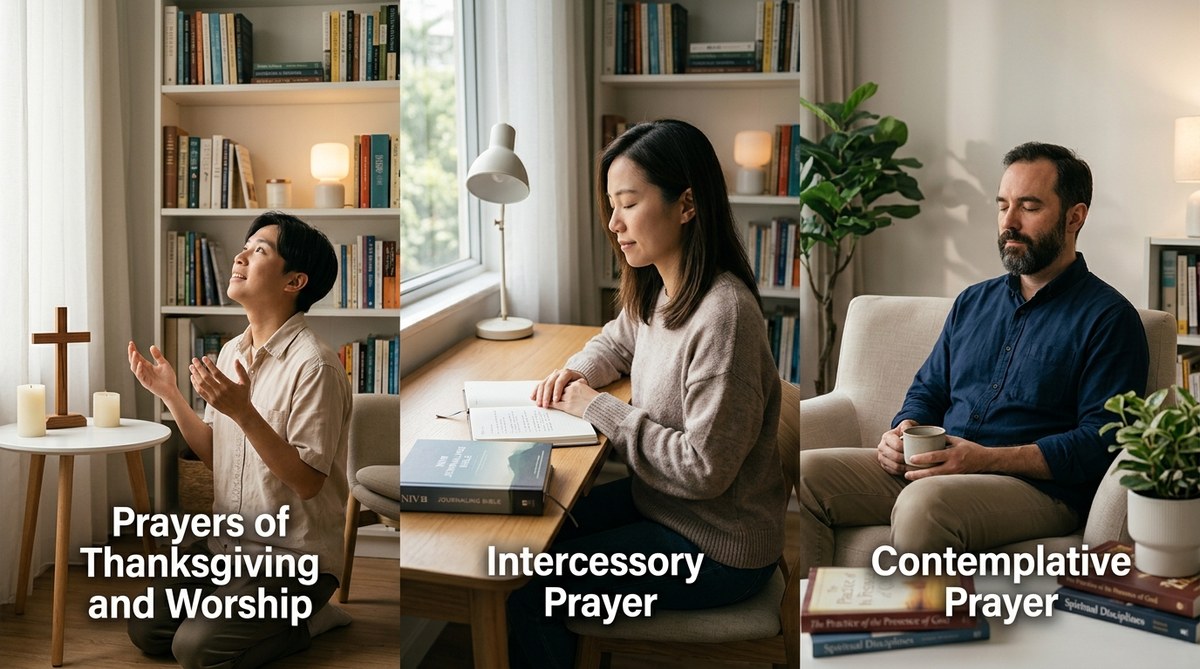
If your prayer life has started to feel like a grocery list of requests or a routine you repeat without thinking, you are not alone. Many Christians get stuck in a pattern of asking, thanking, and moving on. But prayer is more than words you say. It is a relationship with a living God who listens, speaks, and meets you in every season of your heart. The good news is that the Bible and Christian tradition offer rich, ancient forms of prayer that most of us rarely try. Today we will look at three types of prayer you might be missing. Each one can reset your connection with God and bring you into a deeper, more honest faith.
Prayer is not just about talking. It includes grief, silence, and reflection. The prayer of lament lets you bring your hardest emotions to God. Listening prayer teaches you to be still and hear His voice. The prayer of examen helps you see God’s hand in your everyday life. Adding these three types of prayer can turn a stale routine into a living conversation.
The Prayer of Lament: Giving Your Grief a Voice
We often think prayer should be positive. We thank God, praise Him, and ask for help. But what about the times when life falls apart? When a loved one dies, a dream crumbles, or injustice wounds you? Many believers feel pressure to “stay strong” and skip the raw emotions. That is where lament comes in.
Lament is a biblical pattern of prayer that allows you to cry out honestly to God. Almost a third of the Psalms are laments. Think of Psalm 13: “How long, O Lord? Will you forget me forever?” These are not disrespectful words. They are faith that trusts God enough to bring the mess into His presence.
A lament usually has four movements:
- Name your pain. Be specific. Tell God exactly what hurts. Use your own words or borrow from Scripture.
- Cry out to God. Ask Him why. Let your anger or confusion pour out. He can handle it.
- Make a request. Ask for deliverance, healing, or justice.
- Express trust. End with a statement of faith, even a small one. “But I trust in your unfailing love.”
“Lament is not the opposite of faith. It is faith in the raw.” — Adapted from Dan B. Allender
Lament is different from complaining. Complaining usually blames God without turning to Him. Lament turns toward God as the only one who can help. Here is a quick comparison:
| Lament | Complaint |
|---|---|
| Directed to God | Often directed at people or circumstances |
| Honest but reverent | Bitter or entitled |
| Ends with hope | Stays stuck in despair |
| Acknowledges God’s character | Ignores God’s character |
If you have never tried lament, start small. Pick a psalm like Psalm 42 and personalize it. Then write your own version. Let God hear the real you.
For more on handling hard emotions in faith, see our guide on understanding sin, grace, and forgiveness.
The Prayer of Listening: Sitting in Silence Before God
Most of our prayers are monologues. We talk, and then we say “Amen” and get up. But prayer is a dialogue. Jesus often withdrew to quiet places to be with the Father. Elijah heard God not in the wind or fire but in a “still, small voice.”
Listening prayer, sometimes called contemplative prayer, is intentionally setting aside time to be silent in God’s presence. You are not trying to think deep thoughts or solve problems. You are simply waiting, resting, and paying attention to God.
How to practice listening prayer:
- Find a quiet place and a comfortable posture. Sit still. Close your eyes. Breathe slowly.
- Focus on God’s presence. You might use a simple phrase like “Abba, I am here” or imagine Jesus sitting with you.
- Wait without expectation. If your mind wanders, gently return to focusing on God. Listen for any sense of peace, a Scripture verse, or a quiet nudge. Write down anything that comes to mind.
A common mistake is to fill the silence with your own thoughts. Here are some obstacles and solutions:
| Obstacle | Solution |
|---|---|
| Mind wanders to to-do lists | Keep a notebook nearby to write down reminders later |
| Feeling awkward or silly | Start with just 2 minutes and build up |
| Expecting dramatic messages | Remember God often speaks in a whisper |
| Falling asleep | Choose a time when you are alert; sit upright |
Even five minutes of silent listening can change the flavor of your whole day. It reminds you that God is with you, not just a distant listener.
If you want to learn more about discerning God’s voice, check out our article on how to hear God’s voice in a noisy world.
The Prayer of Examen: Reviewing Your Day with God
The prayer of examen is a practice made famous by St. Ignatius of Loyola. It is a simple way to review your day with God and notice where He was at work. Many Christians skip this because they think they need a long quiet time. But examen takes only 10 to 15 minutes and can be done anytime.
Here is a simple five-step version:
- Become aware of God’s presence. Take a deep breath and ask God to be with you as you look back.
- Review the day with gratitude. Walk through your day from morning to night. Thank God for each good gift: a kind word, a meal, a moment of beauty.
- Notice the moments of consolation. Where did you feel close to God, peace, or joy? Those are signs of His presence.
- Notice the moments of desolation. Where did you feel distant, anxious, or tempted? Do not judge yourself. Just notice and talk to God about it.
- Look toward tomorrow. Ask for grace and wisdom for the next day.
Examen is often missed because people think prayer needs to be planned or formal. But it is actually a flexible, honest conversation.
- It turns your day into a prayer.
- It trains you to see God in everyday life.
- It combines gratitude and confession naturally.
- It does not require a special location or time.
Think of it as a spiritual debrief. Just like athletes review game footage, examen helps you see where you played well and where you need growth.
- Time commitment: 10–15 minutes
- Best time: End of the day or before bed
- Required tools: None (a journal can help)
- Key attitude: Curiosity, not guilt
For more ways to build prayer habits, take a look at our 7 daily habits that will transform your prayer life.
Finding Your Rhythm: Weaving These Prayers into Daily Life
Learning new types of prayer is not about adding more items to your spiritual checklist. It is about letting your relationship with God become richer and more real. You do not have to do all three every day. Start with the one that feels most needed.
If you are carrying heavy emotions, try lament. If your mind is noisy and you feel distant from God, try listening prayer. If you want to see God’s fingerprints on your ordinary Tuesday, try examen.
You can rotate them through your week. Monday: lament for a difficult situation. Wednesday: silence for 5 minutes. Saturday: examen before bed. Over time, these prayers will feel less like techniques and more like natural ways to connect with the One who loves you.
God is not looking for perfect prayers. He is looking for your heart. Whether you cry, wait, or reflect, He is there. So take a step. Pick one of these three types of prayer and try it today. You might be surprised at what you have been missing.