

You’ve heard the word Trinity countless times in church. Maybe you’ve nodded along during sermons or recited creeds without really grasping what it all means for your Monday morning or your Friday night struggles.
The Trinity describes God as three distinct persons (Father, Son, Holy Spirit) in one divine nature. This doctrine shapes how Christians pray, experience God’s presence, and understand love and community. Rather than being abstract theology, the Trinity offers a practical framework for relating to God in everyday life, showing us a God who is both transcendent and intimately involved in our stories.
The Trinity Explained Without the Theological Jargon
The Trinity means God exists as three persons who share one divine essence. Think of it as three distinct centers of consciousness, each fully God, yet not three separate gods.
The Father is not the Son. The Son is not the Spirit. The Spirit is not the Father. Yet all three are equally and completely God.
This isn’t about math where 1+1+1=3. It’s more like how water can be ice, liquid, and steam while remaining H2O. Except that analogy breaks down too, because ice isn’t simultaneously liquid. The Trinity is unique.
Christians believe:
- God the Father creates and sustains everything
- God the Son (Jesus) became human to reconcile us to God
- God the Holy Spirit dwells in believers and transforms them
Each person has distinct roles, yet they work in perfect unity. The Father sends the Son. The Son obeys the Father. The Spirit proceeds from both and points us to Jesus.
Why This Matters Beyond Sunday Morning
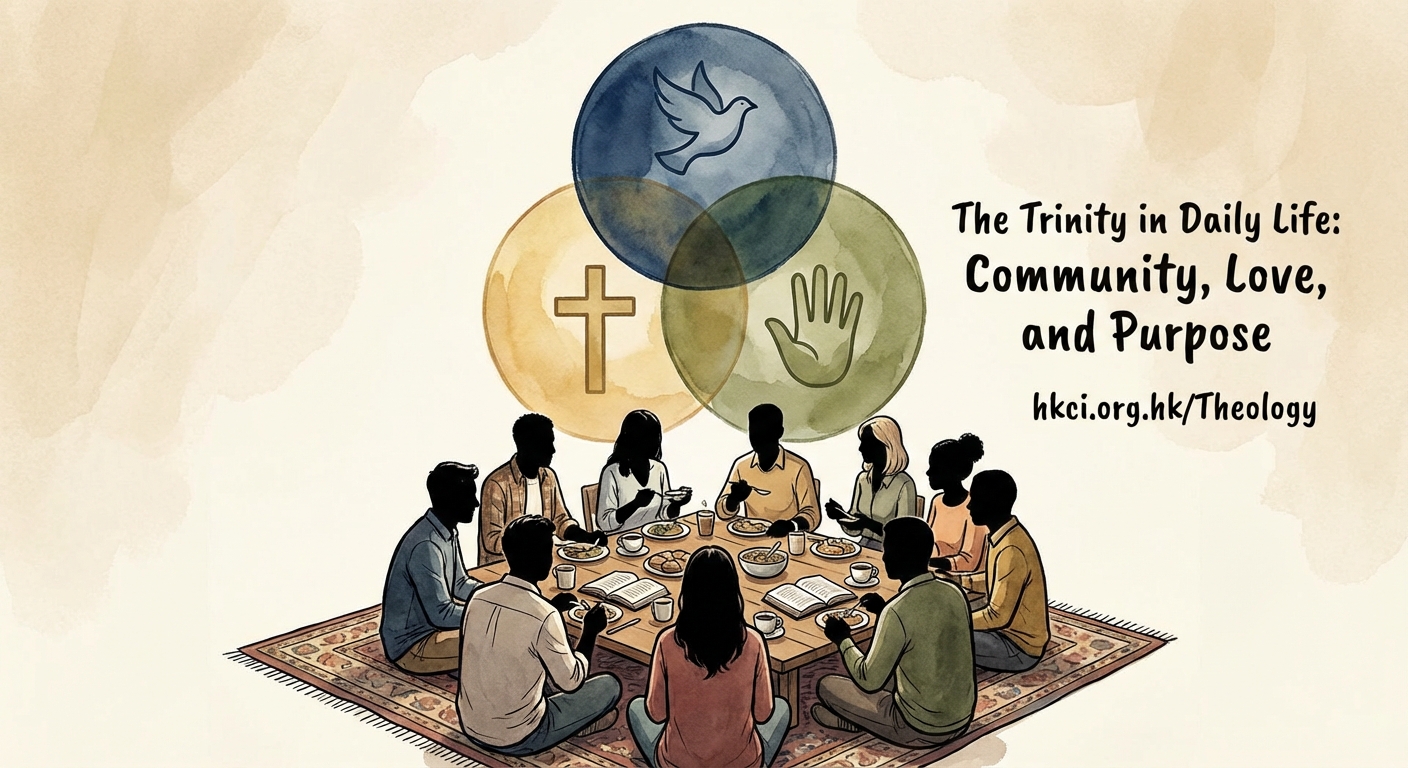
You might wonder why this doctrine deserves attention when there are bills to pay and relationships to mend. Here’s the thing: the Trinity fundamentally changes how you understand God’s character and your place in the world.
A God who is eternally relational didn’t create humans because he was lonely. The Father, Son, and Spirit have loved each other for all eternity. You were created out of overflow, not need.
This means your worth isn’t based on what you produce or achieve. You’re invited into a love that already existed before the foundation of the world.
When you pray, you’re not trying to get the attention of a distant deity. You’re speaking to a Father who sent his Son to die for you and whose Spirit lives inside you. All three persons are invested in your flourishing.
How the Trinity Shapes Your Prayer Life
Understanding the Trinity transforms prayer from a monologue into a conversation within a relationship.
Here’s a practical framework:
- Pray to the Father with confidence because Jesus made you a child of God
- Pray in the name of Jesus because he’s your mediator and advocate
- Pray in the power of the Spirit who helps you when you don’t know what to say
You don’t need to address each person separately every time you pray. But knowing their distinct roles helps when you feel stuck.
Feeling distant from God? Ask the Spirit to help you sense the Father’s love. Struggling with guilt? Remember Jesus already paid for your sins. Overwhelmed by life? The Father holds all things together.
The apostle Paul captures this beautifully when he writes about access to the Father through Jesus by one Spirit. All three persons work together to bring you into God’s presence.
Common Misunderstandings About the Trinity

| Misunderstanding | What It Actually Means | Why It Matters |
|---|---|---|
| Three gods working together | One God in three persons | Christianity is monotheistic, not polytheistic |
| God wearing three different masks | Three distinct persons simultaneously | Each person has unique consciousness and role |
| Jesus is less divine than the Father | All three are equally God | Jesus isn’t a demigod or junior deity |
| The Trinity is just for theologians | Practical foundation for Christian life | Shapes prayer, worship, and relationships |
| You must fully understand it to believe | Mystery we accept by faith | God transcends complete human comprehension |
The Trinity isn’t a puzzle to solve. It’s a reality to embrace. Early Christians didn’t invent this doctrine because they enjoyed complicated theology. They wrestled with what Scripture revealed about God’s nature.
The New Testament shows Jesus praying to the Father, promising to send the Spirit, and claiming equality with God. The early church had to make sense of these claims without abandoning monotheism.
Living Out Trinitarian Faith in Real Relationships
The Trinity gives us a model for healthy relationships. The three persons exist in perfect love, honor, and unity while maintaining distinct identities.
This challenges both extreme individualism and unhealthy codependency. You can be fully yourself while being deeply connected to others. Your identity doesn’t disappear in community, nor does community threaten your individuality.
Think about marriage. Two people become one flesh, yet they remain two distinct persons. They serve each other, defer to each other, and work toward common goals while maintaining their unique gifts and personalities.
Or consider a healthy church. Different members have different roles and gifts. Some lead, some serve, some teach, some encourage. Yet all work together as one body with Christ as the head.
“The Trinity shows us that ultimate reality is relational. God is love not just because he loves, but because love exists eternally within his very nature as three persons in perfect communion.”
This has implications for how you treat people. Every human bears God’s image. That means every person has inherent worth and dignity because they reflect a God who is eternally relational.
The Trinity and Your Spiritual Growth
Spiritual formation isn’t about trying harder to be good. It’s about the Spirit conforming you to the image of the Son so you can relate to the Father as Jesus does.
The Father initiates your salvation. The Son accomplishes it through his death and resurrection. The Spirit applies it to your life through regeneration and sanctification.
You can’t separate these roles. The Father doesn’t save you without the Son. The Son’s work isn’t effective without the Spirit. The Spirit doesn’t work independently of the Father’s will or the Son’s finished work.
This takes pressure off you. Transformation isn’t your solo project. All three persons of the Trinity are actively involved in your growth.
When you fail, you’re not just disappointing yourself. You’re grieving the Spirit, ignoring the Son’s sacrifice, and turning from the Father’s love. But when you repent, all three persons rejoice over your return.
Practical Ways to Engage with the Trinity Daily
Here are concrete practices to make Trinitarian faith more than abstract belief:
- Morning prayer: Thank the Father for a new day, ask Jesus to be present in your activities, invite the Spirit to guide your decisions
- Scripture reading: Notice how all three persons appear throughout the Bible’s story
- Worship: Sing songs that address Father, Son, and Spirit
- Communion: Remember that the Father gave the Son, the Son gave his body and blood, and the Spirit makes Christ present to you
- Service: Recognize that serving others reflects the mutual love and service within the Trinity
- Confession: Confess to the Father, claim forgiveness through the Son, and ask the Spirit for power to change
These practices aren’t religious chores. They’re ways to participate in the life of God.
The goal isn’t to perfectly balance your attention among three persons. The goal is to recognize that you’re relating to one God who has revealed himself as Father, Son, and Spirit.
When the Trinity Feels Too Abstract
Some days the Trinity feels more like a theological puzzle than a living reality. That’s normal. You’re finite, trying to grasp the infinite.
Start with what you know. Jesus is the visible image of the invisible God. If you want to know what God is like, look at Jesus. He shows you the Father’s heart. He sends the Spirit.
Focus on Jesus when the Trinity feels overwhelming. He’s the one who became flesh and lived among us. He’s the one you can read about in the Gospels, touching lepers and eating with sinners.
As you know Jesus better, you’ll naturally grow in understanding the Father who sent him and the Spirit who testifies about him.
Don’t let what you can’t fully comprehend keep you from trusting what God has clearly revealed. The Trinity is a mystery, but it’s not irrational or contradictory. It’s beyond reason, not against it.
How the Trinity Differs from Other Views of God
Christianity’s Trinitarian view sets it apart from other monotheistic religions. Islam emphasizes God’s oneness but rejects the Trinity as polytheism. Judaism affirms God’s oneness but doesn’t recognize Jesus as divine or the Spirit as a distinct person.
Some groups claiming to be Christian also reject the Trinity. Jehovah’s Witnesses teach that Jesus is a created being, not fully God. Oneness Pentecostals believe God is one person who manifests in three modes.
These aren’t just academic distinctions. They affect how you understand salvation, prayer, and God’s character.
If Jesus isn’t fully God, his death can’t reconcile you to God. A created being can’t bridge the infinite gap between holy God and sinful humanity. If the Spirit isn’t God, he can’t transform you from the inside.
The Trinity matters because it tells you who God really is and how he relates to you.
Bringing the Trinity into Focus
The Trinity isn’t meant to be a doctrine you defend but never experience. It’s the framework for knowing God personally.
When you feel alone, remember the Father who calls you his child. When you feel guilty, remember the Son who took your place. When you feel weak, remember the Spirit who empowers you.
The same God who spoke creation into existence now speaks to you. The same God who walked dusty roads in Galilee now walks with you. The same God who raised Jesus from the dead now lives in you.
That’s what the Trinity means. Not three distant concepts, but one God who has made himself known so you can know him, love him, and live in relationship with him today and forever.