

You’ve probably heard the phrase tossed around in church circles, Bible studies, or Christian conversations. “Be in the world but not of the world.” It sounds simple enough. But when you’re scrolling through social media, making career decisions, or choosing how to spend your Friday night, the line between participating in culture and compromising your faith can feel impossibly blurry.
This isn’t just theological theory. It’s a daily tension every believer faces. How do you engage with coworkers who don’t share your values? Can you enjoy movies, music, and entertainment without absorbing worldly attitudes? Where’s the balance between being relatable and being set apart?
Being in the world but not of the world means Christians actively participate in society while refusing to adopt its values that contradict Scripture. This biblical principle calls believers to engage culture with love and truth, maintain distinct moral standards, and prioritize eternal perspectives over temporary pleasures. It’s not about isolation but transformation, living as salt and light while keeping your heart anchored in God’s kingdom rather than earthly systems.
Where this phrase comes from
You might be surprised to learn that the exact phrase “in the world but not of the world” doesn’t appear verbatim in Scripture. But the concept absolutely does.
Jesus prayed these words in John 17:14-16: “I have given them your word and the world has hated them, for they are not of the world any more than I am of the world. My prayer is not that you take them out of the world but that you protect them from the evil one. They are not of the world, even as I am not of it.”
Notice what Jesus didn’t pray. He didn’t ask God to remove believers from society. He didn’t advocate for Christian communes or complete cultural withdrawal. Instead, He acknowledged a fundamental reality: His followers would remain physically present in the world while spiritually belonging to a different kingdom.
Paul reinforces this in Romans 12:2: “Do not conform to the pattern of this world, but be transformed by the renewing of your mind.” The Greek word for “conform” suggests pouring yourself into a mold, taking the exact shape of whatever surrounds you.
James puts it even more bluntly in James 4:4: “Friendship with the world means enmity against God.”
These passages create the framework. Believers occupy physical space in human society while refusing to let that society dictate their values, priorities, or identity.
What “the world” actually means
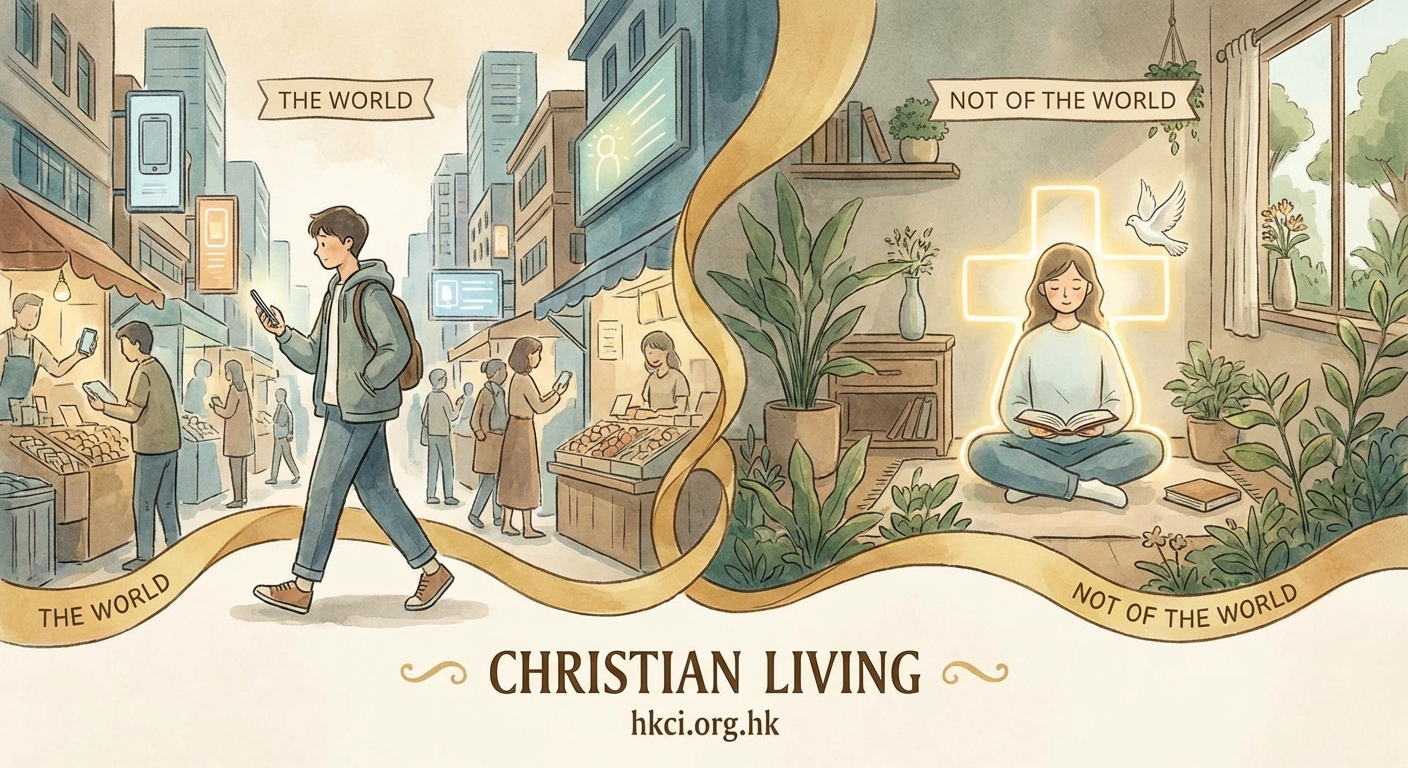
Before you can avoid being “of the world,” you need to understand what Scripture means by “world.”
The Greek word is “kosmos,” and it carries multiple meanings depending on context. Sometimes it simply refers to the physical planet or all humanity. But when Jesus and the apostles warn against “the world,” they’re describing something more specific.
“The world” in this negative sense represents the organized system of human culture operating in rebellion against God. It’s the collection of values, philosophies, entertainment, and priorities that exclude God from consideration.
Think of it as the default settings of human society after the fall. Selfishness over service. Pleasure over purpose. Material success over spiritual growth. Image over character. Temporary satisfaction over eternal significance.
The world isn’t just “bad stuff.” It includes good things twisted into ultimate things. Career becomes identity. Romance becomes salvation. Comfort becomes the highest goal. Entertainment becomes an escape rather than occasional refreshment.
This system surrounds you constantly. It’s in advertising messages, workplace cultures, social media algorithms, entertainment narratives, and even casual conversations. It feels normal because it’s everywhere. That’s precisely what makes it dangerous.
The balance between engagement and compromise
Here’s where many Christians get confused. They swing between two extremes.
Some withdraw completely. They create Christian bubbles with only Christian friends, Christian entertainment, Christian businesses, and Christian social circles. They view secular culture as entirely toxic and avoid contact whenever possible.
Others blend in entirely. They adopt the same language, entertainment choices, relationship patterns, and priorities as their non-believing friends. Their faith becomes a private belief system that rarely influences public behavior or decisions.
Neither extreme reflects biblical teaching.
Jesus Himself provided the model. He attended parties with tax collectors and sinners. He engaged Samaritan women and Roman soldiers. He participated in weddings, dinners, and cultural events. Yet no one ever questioned His holiness or mistook His values for worldly ones.
The Pharisees accused Him of being “a friend of tax collectors and sinners” as an insult. Jesus didn’t deny the association. He simply refused to adopt their sins while loving them as people.
Paul wrote in 1 Corinthians 5:9-10: “I wrote to you in my letter not to associate with sexually immoral people, not at all meaning the people of this world who are immoral, or the greedy and swindlers, or idolaters. In that case you would have to leave this world.”
He clarifies that believers must engage with unbelievers. Isolation isn’t the answer. But participation doesn’t mean participation in sin or adoption of ungodly values.
Practical ways to live this out

Understanding the concept intellectually is one thing. Actually living it requires intentional choices. Here’s a practical framework:
-
Establish your identity before you engage. Know who you are in Christ before you enter spaces that challenge that identity. Regular time in Scripture, prayer, and Christian community aren’t optional extras. They’re the foundation that keeps you anchored when cultural currents pull hard in other directions.
-
Choose participation points wisely. You can’t engage everything. Some activities, environments, or relationships will compromise your witness or weaken your faith. Ask yourself: Does this help me love God and others better? Does this align with biblical values? Will this strengthen or weaken my spiritual life?
-
Maintain visible distinctives. Your coworkers should notice differences in how you speak, what you prioritize, and how you treat people. Not in a self-righteous way, but in a genuinely different way. Your speech should be gracious. Your work ethic should be excellent. Your integrity should be unquestionable. Your kindness should be consistent.
-
Build bridges without burning convictions. You can attend the office party without getting drunk. You can be friendly with neighbors who live differently without endorsing their choices. You can enjoy entertainment without consuming content that contradicts your values. Relationships matter, but truth matters more.
-
Let your presence point beyond yourself. The goal isn’t just to be different. It’s to point people toward Jesus. Your distinctives should spark curiosity, not just judgment. When people ask why you respond differently to stress, treat your spouse with respect, or maintain hope during hardship, you have an opportunity to share what makes you different.
Common mistakes to avoid
Even well-meaning Christians fall into predictable traps when trying to apply this principle. Recognizing these patterns helps you avoid them.
| Mistake | What it looks like | Better approach |
|---|---|---|
| Judgmental separation | Avoiding all contact with non-Christians, treating secular culture as entirely evil | Engage with genuine love while maintaining biblical standards |
| Compromising conformity | Adopting worldly values to seem relatable or avoid conflict | Stand firm on biblical truth while showing grace to people |
| Inconsistent witness | Being “spiritual” on Sunday but worldly Monday through Saturday | Let your faith shape every area of life consistently |
| Cultural irrelevance | Using outdated methods or language that creates unnecessary barriers | Communicate timeless truth in contemporary, accessible ways |
| Self-righteous pride | Feeling superior to “worldly” people instead of humbly grateful for grace | Remember you’re saved by grace, not moral superiority |
The Pharisees made the first mistake. They separated so thoroughly that they became useless to the people they were supposed to reach. They kept themselves pure but failed to be salt and light.
Many modern Christians make the second mistake. They want to be liked, accepted, and included so badly that they compromise clear biblical teachings to fit in.
Both errors miss the point entirely.
What this looks like in different life areas
Abstract principles need concrete application. Here’s how being in the world but not of the world plays out across various contexts:
At work: You show up on time, work diligently, and treat colleagues with respect regardless of their beliefs or behavior. You participate in team activities and build genuine relationships. But you don’t laugh at inappropriate jokes, participate in gossip, or compromise ethical standards for advancement. Your work speaks for itself, and your character stands out.
In entertainment: You can appreciate artistic skill, enjoy stories, and participate in cultural conversations. But you filter content through biblical values. Some movies, shows, or music won’t make the cut because they celebrate what God calls sin or fill your mind with unhelpful content. You’re selective, not legalistic.
In relationships: You befriend people who don’t share your faith. You genuinely care about their lives, celebrate their successes, and support them through struggles. But you don’t pretend to agree with choices that contradict Scripture. You speak truth in love when appropriate and live differently in ways they can observe.
On social media: You engage with current events, share parts of your life, and interact with diverse perspectives. But you don’t get swept into outrage cycles, participate in mob mentality, or let algorithms shape your worldview. Your posts reflect hope, grace, and truth rather than anxiety, anger, or empty entertainment.
In parenting: You don’t shelter your children from all cultural exposure, but you don’t give them unrestricted access either. You teach them to think critically about messages they encounter, help them develop biblical discernment, and model engaged faithfulness rather than fearful withdrawal.
“The Christian is not one who has gone all the way with Christ. None of us has. The Christian is one who has found the right road.” This insight reminds us that living in the world but not of the world isn’t about perfection. It’s about direction. You’re learning to navigate culture with wisdom, growing in discernment, and consistently choosing God’s kingdom values over worldly alternatives.
The transformation factor
Romans 12:2 doesn’t just tell you what to avoid. It tells you what to pursue: transformation through mind renewal.
This is the key difference between legalistic rule-following and genuine spiritual distinctiveness. You’re not just avoiding worldly patterns. You’re being transformed into Christlikeness.
When your mind is renewed by Scripture, you start seeing things differently. Entertainment that once seemed harmless now feels empty. Conversations that once seemed normal now sound hollow. Pursuits that once seemed important now feel trivial. Priorities shift naturally as your perspective changes.
This transformation happens gradually through consistent exposure to God’s Word, the Holy Spirit’s work, and Christian community. You don’t white-knuckle your way through cultural pressures. You grow into someone who genuinely wants different things.
That’s when being “not of the world” stops feeling like restriction and starts feeling like freedom. You’re no longer enslaved to cultural expectations, peer pressure, or the exhausting pursuit of whatever trend currently dominates.
Why this matters more than ever
Cultural pressure to conform has always existed. But modern technology amplifies it exponentially.
Social media creates constant comparison. Algorithms feed you content designed to shape your desires. Entertainment is available 24/7. News cycles generate perpetual outrage. Everyone has a platform to broadcast their values and judge yours.
The world’s voice is louder, more persistent, and more sophisticated than ever before. It doesn’t just knock on your door occasionally. It lives in your pocket, pings throughout your day, and follows you everywhere.
This makes intentionality absolutely essential. You can’t drift into distinctiveness. You won’t accidentally maintain biblical values while passively consuming whatever culture serves you.
You need clear boundaries, regular evaluation, and consistent recalibration. What media are you consuming? Who influences your thinking? What values are you absorbing without realizing it? How is your actual behavior comparing to your stated beliefs?
These aren’t one-time questions. They require ongoing attention because cultural currents constantly shift and pull in new directions.
Living as salt and light
Jesus used two metaphors to describe His followers’ role in the world: salt and light.
Salt preserves and flavors. It’s distinct from the food it touches, but it makes that food better. Light exposes and guides. It doesn’t blend into darkness. It dispels it.
Both metaphors assume contact. Salt sitting in a shaker doesn’t flavor anything. Light hidden under a basket doesn’t illuminate anything. Your faith must touch the world to affect it.
But both also assume distinctiveness. Salt that loses its saltiness is useless. Light that dims until it matches the darkness serves no purpose. Your faith must remain pure to be effective.
This is the tension. You must be close enough to influence but distinct enough to matter. Present enough to be relevant but different enough to point beyond yourself.
It’s not comfortable. It requires wisdom, courage, and constant dependence on God. But it’s exactly what Jesus called you to do.
Living faithfully right where you are
You don’t need to move to a monastery or create a Christian compound to live out this calling. You need to be faithfully present in your actual life right now.
At your job, in your neighborhood, with your family, through your hobbies, and in your daily interactions, you have opportunities to demonstrate what it looks like when someone belongs to God’s kingdom while living in human society. Your coworkers are watching. Your neighbors are noticing. Your children are learning from your example more than your words.
The world needs Christians who engage culture thoughtfully, love people genuinely, stand firm on truth graciously, and point consistently toward something better than what this temporary world offers. That’s what being in the world but not of the world actually means. And that’s what makes your everyday faithfulness matter more than you might realize.