

You’re sitting in traffic, phone buzzing with notifications, mind racing through tomorrow’s deadlines. Somewhere beneath the noise, you sense God might be speaking. But how do you hear Him when everything around you screams for attention?
Hearing God’s voice in a noisy world requires intentional practices: creating silence, studying Scripture, discerning through community, and testing what you hear against biblical truth. God still speaks today, but modern distractions make listening harder. This guide provides biblical foundations and practical steps to recognize His voice amid life’s chaos, helping both new and mature believers develop spiritual clarity.
Why Modern Life Makes Listening Harder
The average person checks their phone 96 times daily. Add work emails, social media, streaming services, and constant news updates. Our brains process five times more information than they did in 1986.
This isn’t just background noise. It rewires how we think.
God hasn’t changed His communication style. We’ve changed our capacity to listen. The Israelites heard God in the wilderness because they had few alternatives. We struggle because we have thousands.
But here’s the good news: learning how to hear God’s voice in a noisy world doesn’t require moving to a monastery. It requires strategy.
What God’s Voice Actually Sounds Like
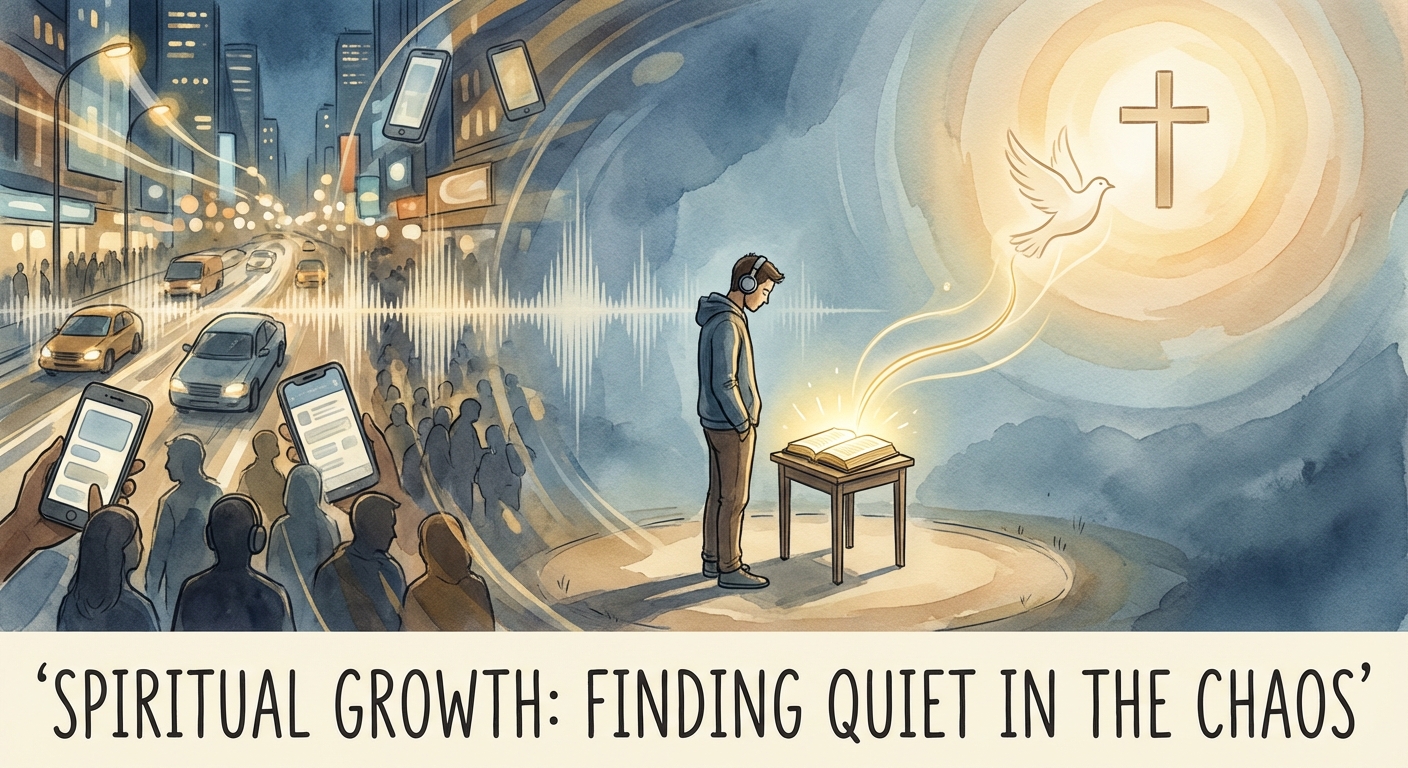
Many Christians expect a booming audible voice. They wait for burning bushes or angelic visits. When those don’t come, they assume God isn’t speaking.
Scripture shows God communicates in multiple ways:
- Through His written Word (2 Timothy 3:16-17)
- Through the Holy Spirit’s gentle promptings (John 16:13)
- Through circumstances and open doors (Acts 16:6-10)
- Through godly counsel (Proverbs 15:22)
- Through creation itself (Psalm 19:1-4)
Most often, God’s voice feels like a persistent thought that aligns with Scripture. It brings peace, not panic. Conviction, not condemnation. Clarity over time, not confusion.
Elijah discovered this after running from Jezebel. God wasn’t in the earthquake, wind, or fire. He spoke in a gentle whisper (1 Kings 19:11-13).
Creating Space to Actually Listen
You can’t hear a whisper in a rock concert. Spiritual listening requires intentional quiet.
Start with Five Minutes
Don’t aim for hour-long prayer sessions if you’ve never practiced silence. Begin small.
Set a timer for five minutes. Sit without your phone. Don’t pray yet. Just breathe. Notice how uncomfortable this feels. That discomfort reveals how addicted we’ve become to noise.
After a week, increase to ten minutes. Then fifteen.
Establish a Consistent Time and Place
Jesus modeled this. He regularly withdrew to solitary places (Luke 5:16). Not because God only speaks in certain locations, but because routine builds the habit.
Morning works for some. Late evening for others. The time matters less than the consistency.
Pick a spot: a chair, a corner of your bedroom, a park bench. Your brain will start associating that place with listening.
Remove Digital Distractions Completely
“I’ll just put my phone on silent” doesn’t work. The mere presence of your device reduces cognitive capacity by 10%, even when turned off. Researchers call this “brain drain.”
Put your phone in another room. Close your laptop. If you use a Bible app, switch to a physical Bible during listening time.
The Foundation: Scripture as God’s Primary Voice

God will never contradict His written Word. Any impression, feeling, or “word from God” that conflicts with Scripture isn’t from Him.
This makes Bible reading non-negotiable for anyone wanting to hear God’s voice in a noisy world.
How to Read for Listening, Not Just Learning
Most of us read the Bible for information. We want to finish chapters, complete reading plans, check boxes.
Listening requires a different approach.
Try lectio divina, an ancient practice:
- Read a short passage slowly, out loud if possible
- Notice which word or phrase catches your attention
- Sit with that phrase, repeating it silently
- Ask God what He’s saying through it
- Respond in prayer to what you sense
This turns Bible reading from a task into a conversation.
The Danger of Proof-Texting
Taking verses out of context to justify what you already want to do isn’t hearing God. It’s manipulating Scripture.
A woman once told me God was leading her to divorce her husband because she “didn’t feel peace.” She quoted Philippians 4:7 about the peace of God.
But God’s Word clearly addresses marriage (1 Corinthians 7, Malachi 2:16). Her lack of peace was a signal to seek counsel and work on the relationship, not abandon it.
Context matters. Always.
Discerning God’s Voice from Other Voices
Not every thought in your head comes from God. Some come from your own desires. Some from cultural conditioning. Some from the enemy.
| Source | Characteristics | Example |
|---|---|---|
| God’s Voice | Aligns with Scripture, brings peace, promotes love | “Forgive that person who hurt you” |
| Your Flesh | Serves self-interest, feels urgent, demands immediate gratification | “You deserve to treat yourself, even if it means debt” |
| The Enemy | Brings shame, creates division, contradicts God’s character | “You’re too broken for God to use” |
| Culture | Reflects popular opinion, changes with trends, fears man’s approval | “Don’t mention Jesus at work, it’s unprofessional” |
Three Tests for What You’re Hearing
Before acting on what you think God is saying, run it through these filters:
Does it align with Scripture? Not just a single verse, but the whole counsel of God’s Word. If you sense God leading you to start a business but it requires lying on your taxes, that’s not God.
Does it produce fruit of the Spirit? Galatians 5:22-23 lists love, joy, peace, patience, kindness, goodness, faithfulness, gentleness, and self-control. God’s direction might be challenging, but it won’t produce anxiety, bitterness, or pride.
Do mature believers confirm it? Proverbs 11:14 says safety comes through many counselors. If every godly person in your life cautions against your “leading from God,” pause and reconsider.
Practical Steps to Hear More Clearly
Here’s a concrete process you can start today:
-
Schedule daily silence. Put it on your calendar like any important appointment. Start with five minutes.
-
Keep a listening journal. Write down impressions, Scripture passages that stand out, and recurring themes. Patterns emerge over time.
-
Fast from something noisy. Social media, podcasts, music in the car. Replace that input with silence or worship.
-
Practice Sabbath rest. One full day each week without productivity pressure. God often speaks when we stop striving.
-
Memorize Scripture. When God’s Word lives in your mind, the Holy Spirit can bring it to remembrance (John 14:26).
-
Ask specific questions. Instead of “God, speak to me,” try “God, how do you see this situation?” or “What do you want me to know about this decision?”
-
Wait expectantly. Don’t fill every silence with words. Give God space to respond.
Common Obstacles and How to Overcome Them
“I Don’t Hear Anything”
Sometimes God’s silence is purposeful. He’s testing your faithfulness when you can’t feel His presence (Deuteronomy 8:2).
Other times, unconfessed sin blocks communication (Isaiah 59:2). Not because God stops loving you, but because sin damages the relationship.
Ask the Holy Spirit to reveal anything separating you from God. Confess it. Receive forgiveness. Then listen again.
“I Hear Too Many Conflicting Things”
This usually means you’re listening to too many voices. Limit your input.
Stop asking twelve people for advice. Stop consuming endless Christian content. Stop bouncing between different spiritual practices.
Focus on Scripture and one or two trusted spiritual mentors.
“What If I Get It Wrong?”
You will sometimes. Every believer does. Peter thought he heard God tell him to build shelters on the mountain (Matthew 17:4). God had other plans.
The key is staying humble and correctable. When you realize you misheard, adjust course. God is patient with sincere seekers.
“My sheep hear my voice, and I know them, and they follow me.” (John 10:27) This isn’t a promise for super-spiritual Christians. It’s the normal Christian life. If you belong to Jesus, you can hear His voice.
Building a Lifestyle of Listening
Hearing God isn’t just for morning devotions. It’s meant to be continuous.
Brother Lawrence, a 17th-century monk, practiced the presence of God while washing dishes. He turned every mundane task into a conversation with God.
You can do this while commuting (turn off the podcast), folding laundry, or walking between meetings.
Ask God about the person you’re about to meet. Thank Him for the food you’re eating. Request wisdom before that difficult conversation.
This constant communication trains your spiritual ears. You become more sensitive to His promptings throughout the day.
When God Speaks Through Others
God often confirms His direction through multiple sources. You read something in Scripture. Then a friend mentions the same theme. Then your pastor preaches on it.
Pay attention to these convergences.
But also be cautious. Not every prophetic word or encouragement from another believer is from God. Test everything (1 Thessalonians 5:20-21).
A healthy church community provides accountability. Share what you’re sensing with mature believers. Let them help you discern.
The Role of Worship in Hearing
Worship shifts your focus from problems to God’s character. It reminds you who’s speaking.
When you’re stuck and can’t hear clearly, worship. Sing. Declare truth about God’s faithfulness, wisdom, and love.
Often, clarity comes not through more analysis but through remembering who God is.
David wrote many psalms in desperate circumstances. The act of worship reoriented his perspective and opened his ears to God’s voice.
Making Room for God in Digital Chaos
You don’t have to delete all social media or throw away your smartphone. But you do need boundaries.
Try these:
- No phones in the bedroom. Use an actual alarm clock.
- Designate phone-free hours, especially first thing in morning and last thing at night.
- Delete apps that trigger mindless scrolling.
- Turn off all non-essential notifications.
- Practice one full day each week without screens.
Every notification is designed to grab your attention. Each one makes it harder to hear the still, small voice.
Protect your attention like the valuable resource it is.
Your Next Steps Matter More Than Perfect Understanding
You won’t master hearing God’s voice by reading this article. You’ll learn by practicing.
Start today. Right now, actually. Put down your phone after finishing this sentence. Sit in silence for five minutes. Tell God you want to hear Him. Then listen.
Don’t expect fireworks. Just notice what comes to mind. Write it down. Compare it to Scripture. Talk about it with a trusted believer.
Do this tomorrow. And the next day. And the day after that.
The world will keep screaming. Notifications will keep buzzing. Distractions will multiply.
But underneath all that noise, God is still speaking. And with practice, patience, and the power of the Holy Spirit, you’ll learn to recognize His voice more clearly than ever before.