
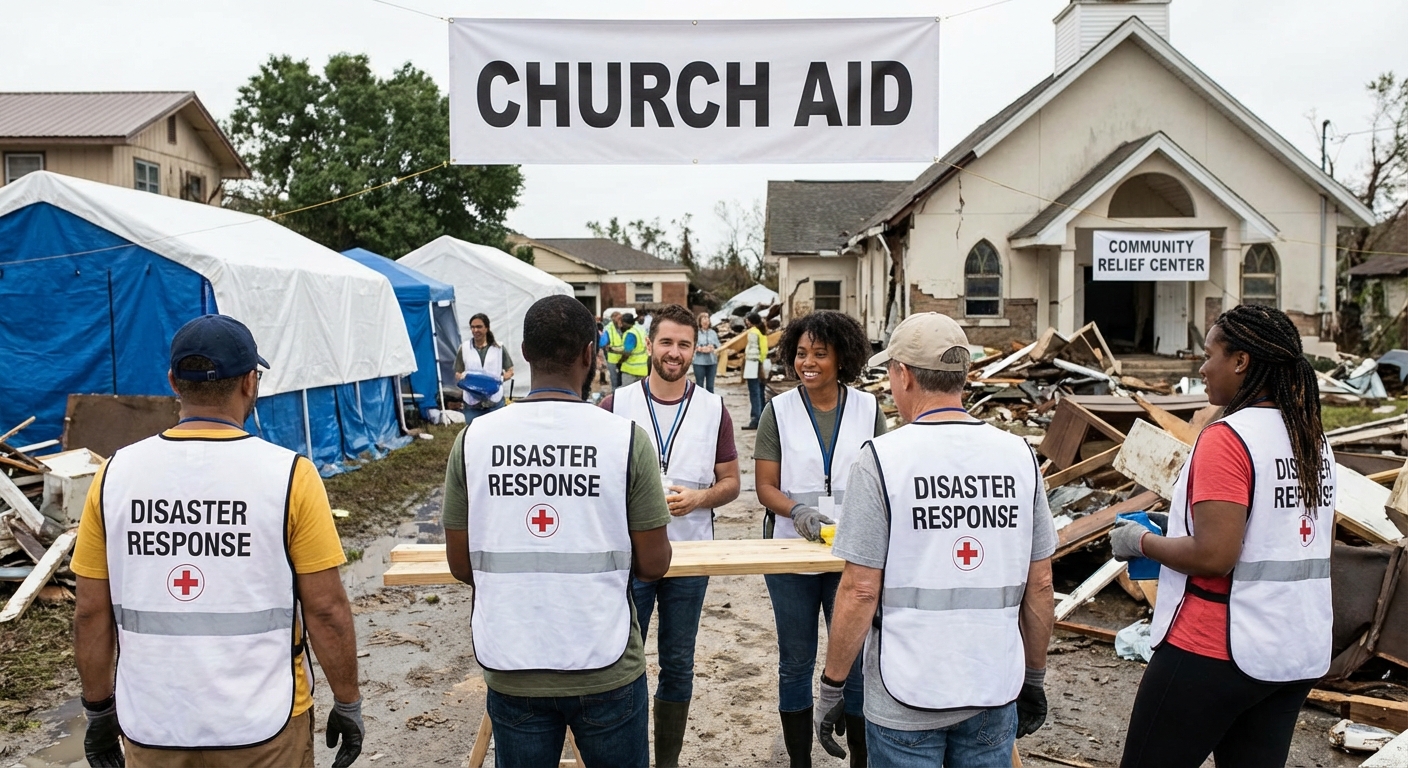
When a hurricane tears through a coastal town or wildfires force entire neighborhoods to evacuate, churches often become the first responders in their communities. While emergency services handle immediate life-threatening situations, faith communities step in to meet the human needs that follow: shelter, food, emotional support, and the long rebuilding process that can stretch for months or years.
Churches respond to natural disasters through three distinct phases: immediate relief providing shelter and supplies, short-term recovery offering cleanup and temporary housing, and long-term rebuilding supporting community restoration. Effective disaster ministry requires pre-planning, strong partnerships with relief organizations, trained volunteers, and sustained commitment beyond the initial crisis when media attention fades and ongoing needs remain greatest.
Understanding the church’s role in disaster response
Churches occupy a unique position in disaster situations. They have existing community trust, physical buildings that can serve as distribution centers or shelters, and networks of volunteers ready to serve.
Most importantly, churches are already embedded in affected neighborhoods. They know the people. They understand local needs. They can identify vulnerable populations that larger relief organizations might miss.
This local knowledge makes faith communities incredibly effective at disaster response. A church knows which elderly members live alone. They know which families were already struggling financially before the disaster struck. They know the community’s culture and can communicate in ways that resonate.
But effective disaster ministry requires more than good intentions. It demands planning, coordination, and realistic expectations about what one congregation can accomplish.
Preparing before disaster strikes

The most effective church disaster responses begin long before any emergency occurs. Preparation makes the difference between chaotic scrambling and organized service.
Smart churches create disaster response teams during calm seasons. These teams develop relationships with local emergency management offices, other congregations, and national relief organizations. They identify potential roles for different church members based on skills and availability.
Pre-positioning supplies helps tremendously. Churches can stockpile non-perishable food, bottled water, cleaning supplies, and hygiene kits. Some congregations maintain trailers equipped with tools for cleanup work.
Training matters too. Churches that invest in volunteer training for debris removal, emotional crisis support, and damage assessment can deploy faster and serve more effectively when disaster hits.
Financial reserves designated specifically for disaster response allow churches to act immediately without waiting for fundraising campaigns or budget approvals.
Immediate response in the first 72 hours
The first three days after a disaster require a different approach than long-term recovery. Immediate needs dominate: safety, shelter, food, water, and medical attention.
During this phase, churches typically:
- Open facilities as emergency shelters if the building remains safe and accessible
- Coordinate with local emergency management to avoid duplicating efforts or creating confusion
- Provide hot meals and distribute water to displaced families and first responders
- Offer charging stations for phones and devices when power is out
- Create communication hubs where people can check on family members
- Distribute emergency supplies like flashlights, batteries, and tarps
The key during immediate response is staying flexible. Plans change constantly as new information arrives about road closures, additional damage, or emerging needs.
Churches should resist the urge to collect physical donations during this phase. Well-meaning clothing and household item drives create sorting and storage problems when immediate needs focus on basics like food and shelter.
Cash donations prove far more useful. Money allows churches to purchase exactly what’s needed and supports local businesses trying to reopen.
Short-term recovery over the following weeks
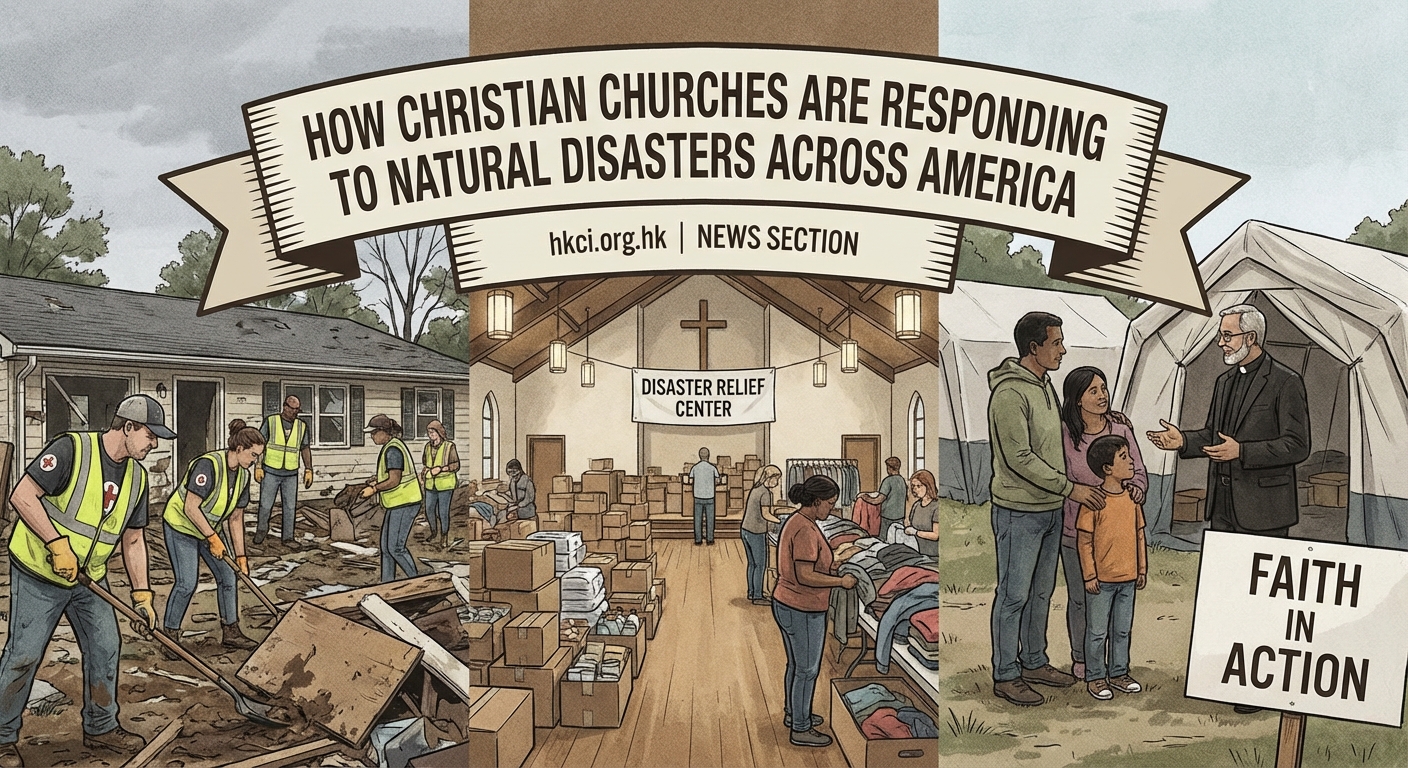
After the initial emergency passes, recovery work begins. This phase typically lasts four to twelve weeks, depending on disaster severity.
Short-term recovery focuses on:
- Mucking out flooded homes (removing wet drywall, insulation, and flooring to prevent mold)
- Tarping damaged roofs to prevent further water intrusion
- Clearing debris from yards and streets
- Providing temporary housing solutions
- Distributing cleaning supplies and replacement household items
- Offering financial assistance for immediate needs
- Connecting survivors with insurance adjusters and government aid programs
This phase requires significant volunteer labor. Many churches organize work teams that travel to affected areas. These teams need coordination, housing, meals, and clear work assignments.
Effective churches create intake systems to assess needs and match them with available resources. Simple databases or even spreadsheets help track which families need help, what work has been completed, and what remains.
Safety becomes critical during cleanup work. Volunteers need proper protective equipment, tetanus shots, and training on hazards like electrical dangers, contaminated water, and structural instability.
Long-term rebuilding and recovery
Most churches excel at immediate response. Many handle short-term recovery well. But few sustain their commitment through the long rebuilding phase that follows.
This is where the greatest need exists.
Long-term recovery can stretch for years. Families living in temporary housing need permanent solutions. Homes require complete rebuilding. Communities must restore infrastructure, businesses, and normalcy.
Churches committed to long-term recovery typically:
- Partner with organizations like Habitat for Humanity or denominational disaster relief agencies
- Hire or designate long-term recovery coordinators who manage ongoing projects
- Continue fundraising efforts months and years after media attention fades
- Provide case management helping families navigate complex rebuilding processes
- Offer ongoing emotional and spiritual support as disaster trauma surfaces
- Advocate for vulnerable populations in recovery planning decisions
The table below outlines common approaches and mistakes during each disaster response phase:
| Phase | Effective Approach | Common Mistake |
|---|---|---|
| Immediate | Coordinate with emergency management, provide basics | Collecting unusable donated items |
| Short-term | Organize trained work teams, systematic needs assessment | Overwhelming communities with uncoordinated volunteers |
| Long-term | Sustained funding, professional coordination, case management | Abandoning recovery work after initial publicity fades |
Building partnerships that multiply impact
No single church can meet all disaster needs alone. Partnerships multiply effectiveness and prevent duplication.
National organizations bring expertise, resources, and experience from previous disasters. Groups like the American Red Cross, Southern Baptist Disaster Relief, and Presbyterian Disaster Assistance have established systems and trained personnel.
Local churches bring community knowledge and sustained presence. The most effective disaster responses combine both.
Interfaith cooperation expands capacity. When churches, synagogues, mosques, and temples work together, they can serve more people and demonstrate unity during crisis.
Partnerships with local businesses provide materials, equipment, and expertise. Construction companies might donate supplies or skilled labor. Restaurants can prepare meals for volunteers and survivors.
Government agencies coordinate overall response and provide funding through FEMA and other programs. Churches that understand how to access these resources can help families navigate bureaucratic processes.
“The most effective disaster ministry happens when churches see themselves as part of a larger ecosystem of care. No organization can do everything, but together we can meet the full spectrum of needs from immediate crisis through complete recovery.” – Disaster relief coordinator with 15 years of field experience
Training and equipping volunteers
Enthusiastic volunteers without proper training can create more problems than they solve. Effective disaster ministry requires skill development.
Basic volunteer training should cover:
- Safety protocols and protective equipment use
- Cultural sensitivity and trauma-informed communication
- Specific skills like chainsaw operation, mold remediation, or construction basics
- Organizational systems for tracking work and resources
- Self-care to prevent volunteer burnout and secondary trauma
Many denominations offer disaster response training programs. FEMA provides free online courses through their Emergency Management Institute. Local community colleges sometimes offer relevant workshops.
Churches should identify volunteers with professional skills: contractors, plumbers, electricians, counselors, nurses, and case managers. These skilled volunteers become team leaders who can train others.
Spiritual and emotional care training matters as much as physical work skills. Volunteers will encounter people experiencing profound loss, trauma, and grief. They need tools for offering appropriate support without causing additional harm.
Managing donations and resources wisely
Financial stewardship becomes critical during disaster response. Donors give generously but expect responsible resource management.
Churches should:
- Create separate disaster relief funds with transparent accounting
- Communicate regularly with donors about how money is being used
- Prioritize direct assistance to affected families over administrative costs
- Resist pressure to spend donated funds too rapidly without proper assessment
- Save reserves for long-term recovery when other funding sources disappear
Physical donations require careful management. Unless specifically requested, most disaster relief experts recommend against collecting used items. New, specific supplies purchased in bulk prove more cost-effective and useful.
If churches do collect physical goods, they need:
- Adequate storage space with climate control
- Volunteer teams to sort and organize items
- Distribution systems matching items to verified needs
- Transportation to deliver supplies
Many churches find it more efficient to raise money and purchase needed items rather than managing donation drives.
Addressing emotional and spiritual needs
Natural disasters create trauma that outlasts physical damage. Families lose homes filled with irreplaceable memories. Communities experience collective grief. Survivors face anxiety, depression, and PTSD.
Churches are uniquely positioned to address these spiritual and emotional dimensions of disaster recovery.
Pastoral care visits provide opportunities for people to process their experiences. Simply listening without trying to fix everything offers tremendous comfort.
Support groups create space for survivors to connect with others who understand their struggles. Facilitated groups focused on disaster recovery can reduce isolation and normalize difficult emotions.
Children need special attention. Disasters disrupt their sense of safety and routine. Churches can provide child-friendly spaces, activities, and counseling designed for young people.
Worship services and prayer gatherings offer communal processing of grief and hope. Liturgy and ritual help communities mark transitions from crisis to recovery.
Some survivors question their faith after disasters. Why did God allow this? Where was divine protection? Churches that create safe space for honest questions demonstrate authentic faith that can hold doubt and struggle.
Sustaining commitment when attention fades
The hardest phase of disaster ministry begins when news cameras leave and social media moves on to other topics.
Six months after a major disaster, most volunteers have returned home. Donation streams slow to a trickle. Yet thousands of families still live in damaged homes or temporary housing. Rebuilding work continues for years.
Churches that make lasting impact commit to marathon ministry, not sprint response.
This requires:
- Realistic timelines acknowledging that recovery takes years, not months
- Rotation systems that prevent volunteer burnout by bringing in fresh teams
- Ongoing fundraising campaigns that maintain financial support
- Celebration of small victories to sustain morale during long rebuilding processes
- Flexibility to adapt as needs change over time
Some churches adopt specific families or neighborhoods for long-term support. This focused approach creates deeper relationships and more comprehensive assistance than spreading resources too thin.
Regular communication with the broader congregation keeps disaster ministry visible even when it’s no longer newsworthy. Stories of individual families rebuilding their lives remind people why sustained support matters.
Measuring impact and learning from experience
After disaster response efforts conclude, thoughtful churches evaluate their work. What went well? What could improve? What lessons apply to future disasters?
Effective evaluation considers:
- Number of families served and types of assistance provided
- Volunteer hours contributed and skills developed
- Financial resources raised and spent
- Partnerships formed and sustained
- Unmet needs that remain
- Volunteer satisfaction and personal growth
- Survivor feedback about helpfulness of assistance
This reflection informs future disaster preparedness. Churches that learn from experience become more effective with each response.
Documentation matters too. Photos, stories, and data create institutional memory that survives pastoral transitions and volunteer turnover. Future disaster response teams can build on previous experience rather than starting from scratch.
Some churches publish reports or case studies sharing their learnings with other congregations. This generosity strengthens the entire faith community’s capacity for disaster ministry.
Turning compassion into lasting change
Churches that respond effectively to natural disasters do more than meet immediate needs. They demonstrate the practical reality of faith in action.
Volunteers discover gifts they didn’t know they possessed. Congregations unite around shared purpose. Communities witness love expressed through tangible service. Survivors experience hope during their darkest moments.
This kind of ministry changes everyone involved.
Start your disaster preparation today, even if no crisis looms on the horizon. Form your response team. Build your partnerships. Train your volunteers. Set aside financial reserves. When disaster inevitably strikes your community or another congregation needs support, you’ll be ready to respond with excellence, compassion, and sustained commitment that carries families all the way through recovery to restoration.