

Two major streams have shaped Protestant theology for centuries. Both honor Scripture. Both affirm salvation through Christ alone. Yet they answer fundamental questions about God’s sovereignty and human responsibility in strikingly different ways.
Calvinism emphasizes God’s absolute sovereignty in salvation, teaching that He chooses who will be saved through unconditional election and irresistible grace. Arminianism affirms God’s sovereignty while maintaining that humans possess genuine free will to accept or reject salvation, with Christ’s atonement available to all. These theological systems differ fundamentally on election, atonement scope, grace, perseverance, and the nature of human choice in redemption.
Understanding the historical context
John Calvin developed his theological framework in Geneva during the 1500s. His systematic approach to Scripture emphasized God’s absolute control over all aspects of salvation. Jacobus Arminius, a Dutch Reformed theologian, later questioned certain Calvinist interpretations in the late 1500s.
The Synod of Dort in 1618-1619 formally rejected Arminian theology and codified the five points of Calvinism. These points respond directly to the five articles of remonstrance that Arminius’s followers presented.
The debate has never truly ended. Churches today still identify strongly with one position or the other. Understanding these differences helps you grasp why Christians who love the same Bible reach different conclusions about salvation.
Total depravity versus partial depravity
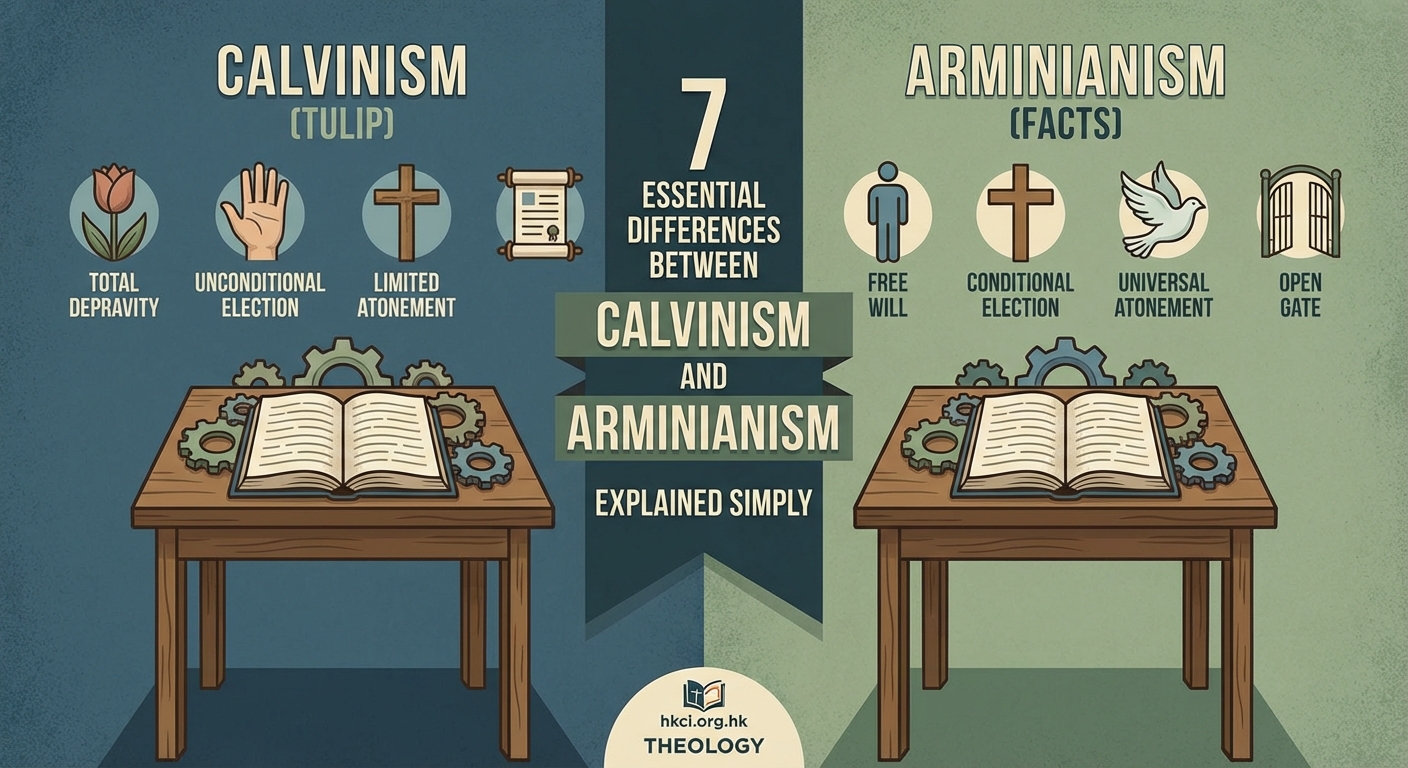
Calvinists teach total depravity. This means sin has corrupted every part of human nature. People cannot choose God on their own. They are spiritually dead, not merely sick.
Think of it like a person at the bottom of the ocean. They cannot swim to the surface. They need complete rescue.
Arminians also believe in human sinfulness but see it differently. Humans are depraved, but God gives prevenient grace to everyone. This grace enables people to respond to the gospel. They can choose to accept or reject Christ.
The Arminian view sees humanity more like a drowning person who can grab the life preserver thrown to them. They still need rescue, but they participate in accepting it.
| Theological Point | Calvinist View | Arminian View |
|---|---|---|
| Human condition | Totally unable to choose God | Enabled by prevenient grace to respond |
| Spiritual state | Dead in sin | Sick but responsive to grace |
| Will capacity | Bound, needs regeneration first | Freed by grace to choose |
Unconditional versus conditional election
Election refers to how God chooses who will be saved. This represents perhaps the sharpest difference between the two systems.
Calvinists believe in unconditional election. Before the foundation of the world, God chose specific individuals for salvation. This choice had nothing to do with foreseen faith, works, or any human quality. God simply decided in His sovereign will whom He would save.
Romans 9 serves as a key text for this view. Paul writes about God choosing Jacob over Esau before either was born or had done anything good or bad.
Arminians teach conditional election. God chose to save all who would believe in Christ. Election is based on God’s foreknowledge of who would accept the gospel. God looked down the corridors of time, saw who would believe, and elected them based on that foreseen faith.
The Calvinist asks, “Why did I believe when others didn’t?” and answers, “Because God chose me.” The Arminian asks the same question and answers, “Because I chose to believe when others didn’t.”
This difference shapes how believers understand their salvation story. Calvinists see themselves as chosen before they believed. Arminians see themselves as choosing to believe in response to God’s universal call.
Limited versus unlimited atonement
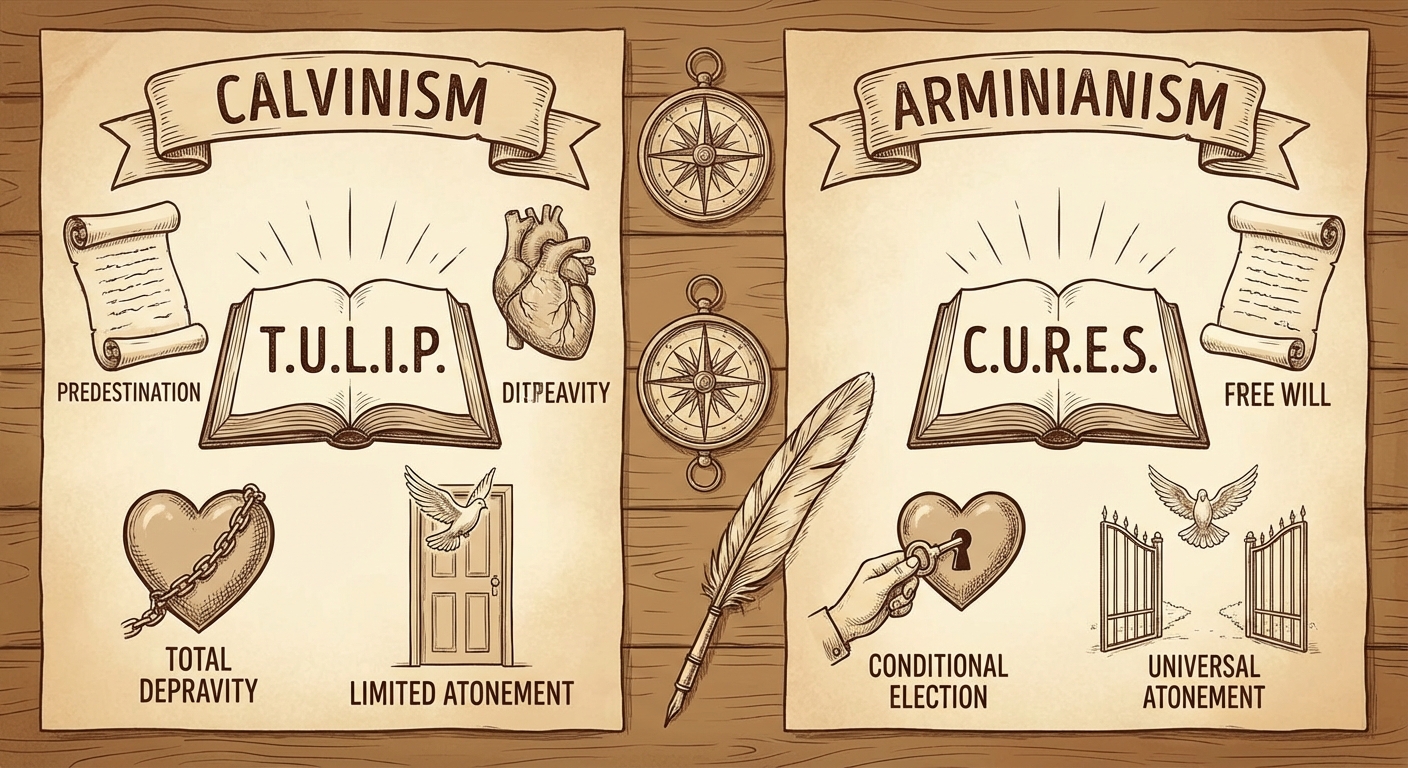
The scope of Christ’s death divides these systems clearly.
Calvinists hold to particular redemption, often called limited atonement. Christ died specifically for the elect. His death actually secured salvation for those God chose. The atonement was limited in scope but infinite in power. It actually saved rather than merely making salvation possible.
Arminians believe in unlimited atonement. Christ died for every person. His death made salvation available to all. Anyone can be saved if they believe. The atonement was unlimited in scope but limited in application. It becomes effective only for those who believe.
Consider these practical implications:
- Calvinists can say Christ died specifically for them with certainty
- Arminians can offer the gospel to anyone, knowing Christ died for that person
- Calvinists emphasize the effectiveness of the cross
- Arminians emphasize the universal offer of salvation
Both views honor Christ’s sacrifice. They simply understand its intended scope differently.
Irresistible versus resistible grace
How does God’s grace work in salvation? Can people reject it?
Calvinists teach irresistible grace, sometimes called effectual calling. When God decides to save someone, His grace cannot be resisted. He changes the heart so that the person willingly comes to Christ. The person doesn’t feel coerced, but they will certainly believe because God makes them willing.
Jesus said no one can come to Him unless the Father draws them. Calvinists interpret this drawing as effectual. Everyone whom the Father draws will come.
Arminians believe grace can be resisted. God calls everyone. He provides grace to enable response. But people can and do reject this grace. The Holy Spirit works to convict and draw, but humans retain the ability to say no.
Stephen accused the religious leaders of always resisting the Holy Spirit. Arminians point to this as evidence that grace can be refused.
Here’s how this plays out in evangelism:
- Calvinists pray for God to change hearts, knowing only He can make people willing
- Arminians pray for people to respond positively to the grace already offered
- Calvinists trust that the elect will eventually believe
- Arminians recognize that some will persistently refuse God’s call
Perseverance versus possible apostasy
Can a true believer lose their salvation? This question has pastoral implications.
Calvinists affirm the perseverance of the saints. Those whom God chose and saved will persevere to the end. They cannot lose their salvation. God will preserve them. If someone appears to fall away permanently, they were never truly saved.
Jesus said He gives eternal life and no one can snatch His sheep from His hand. Calvinists take this as an absolute promise.
Classical Arminians believe true Christians can lose their salvation through persistent unbelief. Salvation can be forfeited. Believers must continue in faith. Many modern Arminians hold various positions on this, with some believing in eternal security.
The practical difference shows up in pastoral care:
- A struggling Calvinist finds comfort that God will keep them
- A struggling Arminian finds motivation to hold fast to faith
- Calvinists counsel doubters to examine whether they were truly saved
- Arminians counsel doubters to return to faith before it’s too late
The role of human free will
How free is human choice in salvation?
Calvinists define freedom as doing what you most want to do. Before salvation, people want to sin. They freely choose sin because that’s their nature. After God regenerates them, they freely choose Christ because He changed their desires. Freedom doesn’t mean ability to choose otherwise. It means acting according to your nature without external compulsion.
Arminians define freedom as the ability to choose between genuine alternatives. Enabled by prevenient grace, people can truly choose to believe or not believe. This libertarian free will means the person could have chosen differently under identical circumstances.
Consider a person hearing the gospel:
- Calvinist view: If God has chosen them, they will believe because God changes their heart
- Arminian view: They can genuinely choose to believe or reject the message
Both affirm that salvation is entirely by grace. They differ on whether grace works by enabling choice or by ensuring a specific outcome.
Sovereignty and responsibility together
Both systems wrestle with the same biblical tension. Scripture clearly teaches God’s absolute sovereignty. It equally clearly holds humans responsible for their choices.
Calvinists prioritize God’s sovereignty and work to fit human responsibility within that framework. They argue that God’s decree doesn’t eliminate genuine human choice or responsibility. People still do what they want.
Arminians prioritize meaningful human choice and work to fit God’s sovereignty within that framework. They argue that God sovereignly chose to create beings with free will and to respect those choices.
Neither system claims to fully resolve the mystery. Both acknowledge that finite minds cannot completely comprehend how divine sovereignty and human responsibility relate.
Where both systems agree
Despite their differences, Calvinists and Arminians share core Christian beliefs:
- Salvation is by grace alone through faith alone in Christ alone
- Scripture is the authoritative Word of God
- Humans are sinful and need redemption
- Christ’s death and resurrection provide the only way of salvation
- The Holy Spirit is essential in bringing people to faith
- Believers should grow in holiness
- Christ will return and judge the world
These agreements matter more than the differences. Both groups belong to the orthodox Christian tradition. Both have produced godly believers, faithful churches, and effective missionaries.
Practical implications for your faith
Your view on these questions affects how you:
- Pray for unbelievers
- Share the gospel
- Understand your own conversion
- Counsel struggling believers
- View God’s character
- Experience assurance of salvation
A Calvinist finds deep comfort in God’s sovereign control. They rest in the certainty that God will complete what He started. They trust that nothing can separate them from His love because He chose them.
An Arminian finds motivation in genuine choice. They value the dignity God gave humans in creating them with free will. They appreciate that love requires the freedom to choose or refuse.
Making sense of the differences
These theological systems developed as sincere believers studied Scripture. Both sides can point to biblical texts supporting their views. Both have strengths and face challenges.
You don’t need to choose a side immediately. Study Scripture. Read theologians from both traditions. Pray for wisdom. Discuss with mature believers who hold different views.
Some Christians hold modified positions, taking elements from both systems. Others firmly plant themselves in one camp. The key is holding your views with both conviction and humility.
Remember that your salvation doesn’t depend on getting every theological detail right. It depends on Christ alone. These discussions should deepen your appreciation for God’s grace, not create division among believers.
Growing in theological understanding
The differences between Calvinism and Arminianism have shaped Protestant thought for four centuries. They will likely continue shaping it for centuries more. Each system offers a coherent way to understand Scripture’s teaching on salvation.
Study both perspectives carefully. Recognize that brilliant, godly scholars stand on each side. Let the discussion drive you deeper into Scripture rather than into camps. Allow these questions to increase your wonder at the mystery of salvation rather than your confidence in having all the answers.
Most importantly, let theological study lead to worship. Whether you conclude that God’s sovereignty means He chose you before the foundation of the world, or that His grace enabled you to choose Him, the result is the same. You are saved by grace through faith in Christ. That truth should fill you with gratitude, humility, and joy.