

The doctrine of original sin shapes how millions understand salvation, baptism, and human nature. Yet many Christians today wonder whether this teaching comes directly from Scripture or developed later through church interpretation. The question matters because it affects how we read Genesis, understand Romans, and approach core theological issues.
Original sin as a formal doctrine emerged through Augustine in the 4th century, though biblical texts address human sinfulness and Adam’s role. Scripture describes universal sin and death through Adam, but scholars debate whether this means inherited guilt or inherited consequences. The Bible presents clear evidence of humanity’s fallen condition while leaving room for different interpretations about transmission and culpability.
What Original Sin Actually Claims
Original sin refers to the idea that Adam’s first transgression affected all his descendants. Most formulations include three components.
First, humans inherit a corrupted nature prone to sin. Second, everyone bears guilt for Adam’s disobedience. Third, this condition passes automatically through biological descent.
Different traditions emphasize different aspects. Eastern Orthodox churches focus on mortality and corruption rather than inherited guilt. Roman Catholic theology teaches that baptism removes the guilt but not the tendency toward sin. Reformed traditions often describe total depravity, meaning sin affects every part of human nature.
The doctrine answers a practical question: why do people sin even when they know better? It explains why moral effort alone cannot fix the human condition.
Key Biblical Passages Used to Support the Doctrine
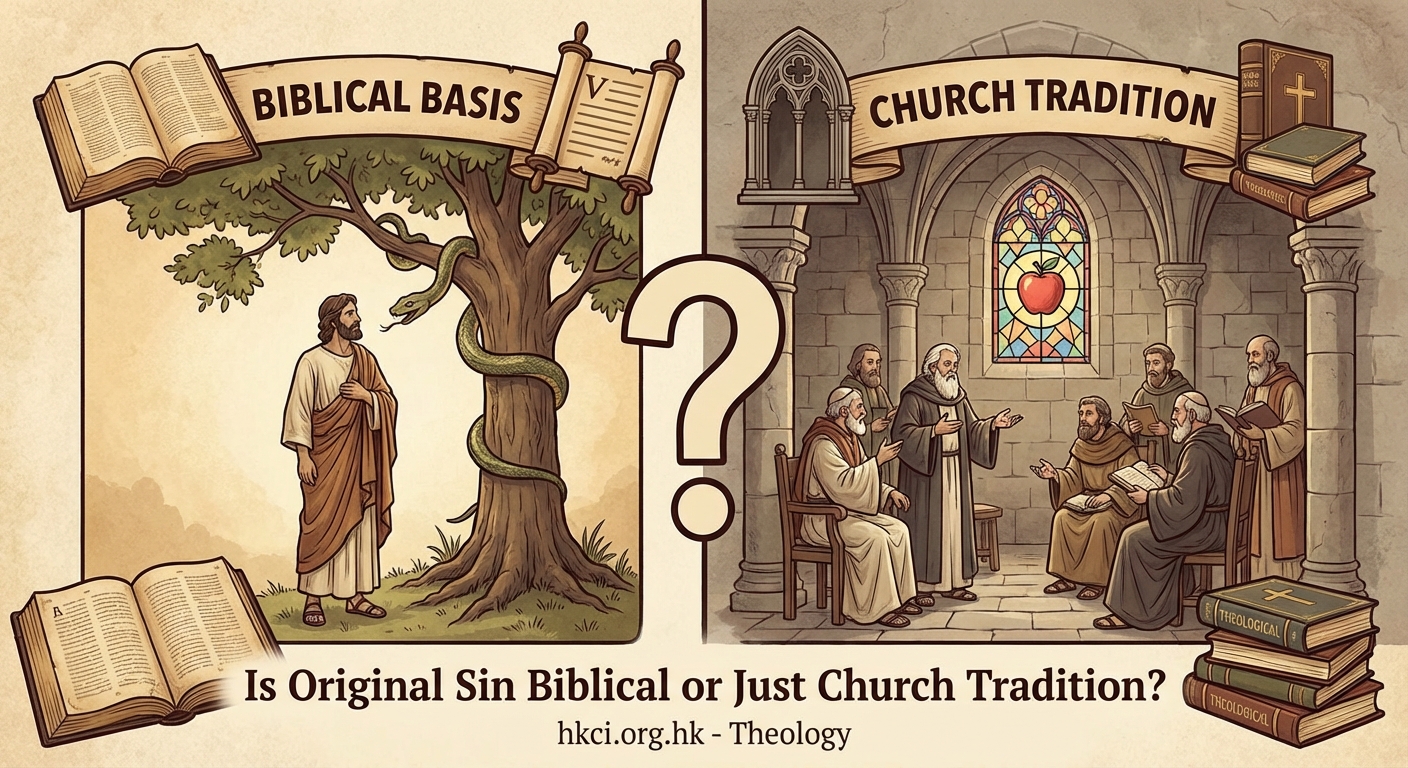
Proponents of original sin point to several Scripture texts as foundational.
Romans 5:12-19
Paul writes that sin entered the world through one man, and death through sin. He states that death spread to all people because all sinned. The passage draws a parallel between Adam and Christ.
The Greek phrase “eph ho pantes hemarton” has sparked debate for centuries. Does it mean “because all sinned” or “in whom all sinned”? Augustine favored the latter, suggesting all humanity sinned in Adam. Modern translations typically render it as “because all sinned,” which could mean either inherited guilt or individual acts.
Paul emphasizes that many died through one man’s trespass. He contrasts the one act of disobedience that brought condemnation with Christ’s one act of righteousness that brings justification.
1 Corinthians 15:21-22
Paul states that death came through a man, and resurrection also through a man. In Adam all die; in Christ all will be made alive.
This passage focuses on death as the consequence of Adam’s sin. It does not explicitly mention guilt or moral corruption, though theologians infer these from the broader context.
Psalm 51:5
David confesses: “Surely I was sinful at birth, sinful from the time my mother conceived me.”
Supporters of original sin see this as evidence of inherited corruption from conception. Critics argue David uses poetic hyperbole to express the depth of his guilt after his sin with Bathsheba, not to make a systematic theological statement.
Ephesians 2:3
Paul describes believers’ former state as “by nature deserving of wrath,” suggesting an inherent condition rather than just accumulated personal sins.
The phrase “by nature” (physei) indicates something innate rather than learned. This supports the idea of inherited sinfulness.
Biblical Evidence That Raises Questions
Other passages complicate the picture and have led some scholars to question whether original sin as traditionally formulated appears in Scripture.
Ezekiel 18
The entire chapter argues against inherited guilt. God declares that children will not bear the punishment for their parents’ sins. Each person dies for their own sin.
Verse 20 states clearly: “The one who sins is the one who will die. The child will not share the guilt of the parent, nor will the parent share the guilt of the child.”
This directly challenges the idea that all humans bear guilt for Adam’s sin. Defenders of original sin respond that Ezekiel addresses generational sins within families, not the unique case of Adam as humanity’s representative.
Deuteronomy 24:16
The law commands that parents shall not be put to death for their children, nor children for their parents. Each person dies for their own sin.
This principle of individual responsibility appears throughout the Old Testament. It sits uncomfortably with the notion of inherited guilt.
James 1:13-15
James describes sin as arising from personal desire. Each person is tempted when dragged away by their own evil desire. Desire gives birth to sin, and sin results in death.
This passage traces sin to individual choice rather than inherited condition. It does not mention Adam or any external source of corruption.
Historical Development of the Doctrine
Understanding when and how the doctrine developed helps answer whether it comes from Scripture or tradition.
Early Church Fathers
The earliest Christian writers did not articulate original sin as Augustine later would. They acknowledged that Adam brought death and that all humans sin, but they did not systematically develop inherited guilt.
Justin Martyr and Irenaeus in the 2nd century saw Adam’s sin as introducing mortality and setting a bad example. They emphasized human free will and the possibility of choosing righteousness.
Origen in the 3rd century suggested pre-existence of souls and saw earthly birth as a consequence of previous sins, not inheritance from Adam.
Augustine’s Formulation
Augustine of Hippo in the late 4th and early 5th centuries gave original sin its classic Western form. His debates with Pelagius, who denied inherited sin, forced him to systematize his views.
Augustine argued that all humanity existed seminally in Adam. When Adam sinned, all sinned. Guilt and corruption pass through procreation. Only God’s grace can rescue people from this condition.
His interpretation of Romans 5:12 relied partly on the Latin Vulgate translation, which rendered the Greek differently than modern scholars would.
Eastern Christian Perspective
Eastern Orthodox theology developed differently. It emphasizes ancestral sin rather than original sin. Humanity inherits mortality and corruption, but not personal guilt for Adam’s act.
This tradition stresses that people become guilty through their own sins, not through inheritance. Death and the tendency toward sin pass to all, but guilt remains individual.
Theological Interpretations Across Traditions
Different Christian traditions read the biblical evidence in distinct ways.
| Tradition | View of Adam’s Sin | Inherited Element | Role of Baptism |
|---|---|---|---|
| Roman Catholic | Brought guilt and concupiscence | Both guilt and tendency to sin | Removes guilt, leaves concupiscence |
| Reformed/Calvinist | Total depravity resulted | Guilt and corrupt nature | Sign of covenant inclusion |
| Eastern Orthodox | Introduced death and corruption | Mortality and weakened nature | Grants new life in Christ |
| Arminian | Corrupted human nature | Tendency to sin, not guilt | Obedience and public profession |
| Pelagian (historical) | Set bad example only | Nothing inherited | Obedience to teaching |
Each tradition claims biblical support. The differences often hinge on how to weigh competing texts and whether to prioritize systematic coherence or individual passage interpretation.
Arguments That Original Sin Is Biblical
Theologians who affirm the doctrine as scriptural make several points.
-
Universal sinfulness requires explanation. Romans 3:23 states that all have sinned. If sin were merely learned behavior, some isolated cultures would remain sinless. The universality suggests something deeper.
-
Death before personal sin. Infants die before committing conscious sins. If death is the wages of sin, and infants die, they must be under sin’s power somehow.
-
Paul’s Adam-Christ parallel. Romans 5 and 1 Corinthians 15 draw tight parallels between Adam and Christ. If Christ’s righteousness is imputed to believers, the parallel suggests Adam’s sin is imputed to humanity.
-
Need for infant baptism. The early church practice of baptizing infants makes sense if they need cleansing from inherited sin. If they have no sin, why baptize them?
-
Human inability. Scripture repeatedly describes humans as unable to save themselves or choose God without divine initiative. This fits with a deeply corrupted nature from birth.
“The doctrine of original sin is the only empirically verifiable doctrine of the Christian faith.” This quote, often attributed to G.K. Chesterton, suggests that human moral failure across all cultures and times provides practical evidence for the teaching.
Arguments That It Is Later Tradition
Scholars who question the biblical basis for original sin point to different evidence.
The term never appears in Scripture. While “original sin” describes a theological concept, the Bible never uses this phrase or explicitly teaches inherited guilt.
Old Testament silence. Apart from Psalm 51:5, which may be poetic, the Hebrew Scriptures do not teach that people inherit Adam’s guilt. They emphasize individual responsibility.
Jesus never mentioned it. Christ spoke often about sin and repentance but never referenced inherited guilt from Adam. His teaching focused on personal choices and heart attitudes.
Early church diversity. If the doctrine were clearly biblical, we would expect uniform teaching from the beginning. Instead, we find development and debate over centuries.
Alternative explanations exist. Universal sinfulness could result from social learning, spiritual forces, or the cumulative effect of living in a fallen world. Inherited guilt is one explanation among several.
Three Ways to Approach the Biblical Evidence
If you are working through this question yourself, consider these steps.
-
Read the key passages in context. Look at Romans 5, 1 Corinthians 15, Ezekiel 18, and Deuteronomy 24 in their full literary and historical contexts. Notice what each author emphasizes and what questions they address.
-
Distinguish between what Scripture states and what it implies. The Bible clearly teaches universal sinfulness and death through Adam. Whether this means inherited guilt or inherited consequences requires interpretation.
-
Consider how your conclusion affects other doctrines. Your view on original sin connects to beliefs about salvation, baptism, human nature, and God’s justice. Think through these connections carefully.
Practical Differences the Debate Creates
This theological question has real-world implications.
Baptism practices vary. Churches that emphasize inherited guilt typically baptize infants. Those that see sin as primarily personal often practice believer’s baptism only.
Evangelism approaches differ. If people are guilty from birth, evangelism stresses rescue from condemnation. If guilt comes through personal sin, evangelism emphasizes turning from wrong choices.
Views of children change. Are unbaptized infants who die lost because of Adam’s guilt? Or are they innocent until they personally sin? Different answers bring different pastoral approaches.
Theodicy questions arise. If God holds people guilty for Adam’s sin, how is that just? Defenders argue Adam represented humanity. Critics see this as incompatible with biblical justice.
Common Misconceptions to Avoid
Several misunderstandings cloud this discussion.
-
Misconception: Denying original sin means denying universal sinfulness. You can affirm that all people sin without accepting inherited guilt. The question is how sin becomes universal.
-
Misconception: The doctrine is entirely Augustine’s invention. While Augustine systematized it, earlier writers acknowledged Adam’s impact on humanity. The debate concerns the specifics, not whether Adam matters.
-
Misconception: This is just academic theology with no practical impact. Your view affects how you understand baptism, evangelism, and God’s character. It shapes pastoral care and personal spirituality.
-
Misconception: One side has all the biblical evidence. Both positions can cite Scripture. The question involves how to weigh and interpret texts that seem to point in different directions.
Where Scholars Stand Today
Academic biblical scholarship shows diversity on this question.
Many historical-critical scholars question whether Paul taught original sin as Augustine formulated it. They see Romans 5 as addressing death and sin’s power without necessarily teaching inherited guilt.
Evangelical scholars often defend the doctrine but with various nuances. Some emphasize federal headship, where Adam represented humanity. Others focus on seminal headship, where humanity was “in” Adam.
Catholic and Orthodox scholars maintain their traditional positions while engaging modern biblical studies. They often emphasize that doctrine develops through church tradition interpreting Scripture, not from Scripture alone.
Jewish scholars note that Judaism never developed a doctrine of original sin. This raises questions about whether the Hebrew Scriptures, which Christians and Jews share, support the concept.
Making Sense of the Competing Views
How should thoughtful Christians navigate this debate?
Recognize what is clear. Scripture unambiguously teaches that all people sin, that Adam’s transgression had catastrophic consequences, and that humanity needs divine rescue. These points unite Christians across traditions.
Acknowledge what requires interpretation. The mechanism by which Adam’s sin affects his descendants, whether people bear guilt or just consequences, and how this relates to infant mortality all require interpretive decisions beyond the plain text.
Respect different conclusions. Sincere Christians reading the same Bible reach different conclusions on this question. The debate has continued for 1,600 years among people committed to Scripture’s authority.
Focus on practical unity. Christians who disagree on original sin can agree on the need for salvation through Christ, the call to holy living, and the power of grace to transform lives.
What This Means for Your Faith
Whether original sin is explicitly biblical or represents theological development matters less than what you do with the underlying truths.
You are a sinner who needs God’s grace. That remains true whether you inherited guilt from Adam or accumulated it through personal choices. The solution is the same: faith in Christ.
You cannot save yourself through moral effort. Whether you call it total depravity or just acknowledge human weakness, you need divine help. The gospel offers that help freely.
Children matter to God. Whether you baptize infants or dedicate them, the call is to raise them in faith and trust God’s goodness toward them.
The doctrine of original sin attempts to explain the human condition we all observe. People everywhere struggle with selfishness, cruelty, and moral failure. Whatever theological explanation you prefer, the reality demands a response.
Scripture gives us the response: repentance, faith, and transformation through Christ. That message transcends debates about how sin originated and focuses on how sin ends.