

Predestination and free will sit at the heart of some of Christianity’s most heated debates. These concepts have divided denominations, sparked theological controversies, and left countless believers confused about how God’s sovereignty relates to human choice.
Many Christians wrestle with questions that seem to pit God’s control against human freedom. Does predestination mean we’re just puppets? If God chooses who gets saved, why bother evangelizing? Can we really be held accountable if everything is predetermined?
These aren’t just academic questions. They affect how we pray, share our faith, and understand our relationship with God.
Misconceptions about predestination and free will often stem from viewing them as contradictory rather than complementary truths. God’s sovereign choice and human responsibility coexist in Scripture without canceling each other out. Understanding both concepts correctly helps believers avoid fatalism, appreciate God’s grace more fully, maintain evangelistic passion, and trust divine justice. These doctrines work together to display God’s glory and human accountability within his redemptive plan.
Misconception one: predestination eliminates human responsibility
Perhaps the most common misunderstanding is that predestination turns humans into robots. If God has already decided who will be saved, people assume our choices don’t matter.
This view misses a crucial biblical pattern. Scripture consistently presents both divine sovereignty and human responsibility as true simultaneously.
The Bible never suggests that God’s sovereign choice removes human accountability. Paul writes in Philippians 2:12-13 that believers should “work out your own salvation with fear and trembling, for it is God who works in you.” Both realities operate at once.
Consider the crucifixion of Jesus. Acts 2:23 describes it as happening by “the predetermined plan and foreknowledge of God,” yet those who crucified Christ were still held responsible for their actions. Peter doesn’t tell the crowd, “Don’t worry, you were just following the script.” He calls them to repentance.
This pattern appears throughout Scripture:
- Joseph tells his brothers that what they meant for evil, God meant for good
- Pharaoh hardens his own heart, and God hardens Pharaoh’s heart
- Jesus prays “not my will, but yours be done,” showing two wills operating
The biblical writers saw no contradiction here. They held both truths without feeling the need to resolve the tension.
Human choices are real and meaningful. We make genuine decisions. We bear responsibility for those decisions. God’s sovereignty doesn’t negate this reality but establishes it.
Misconception two: predestination makes evangelism pointless
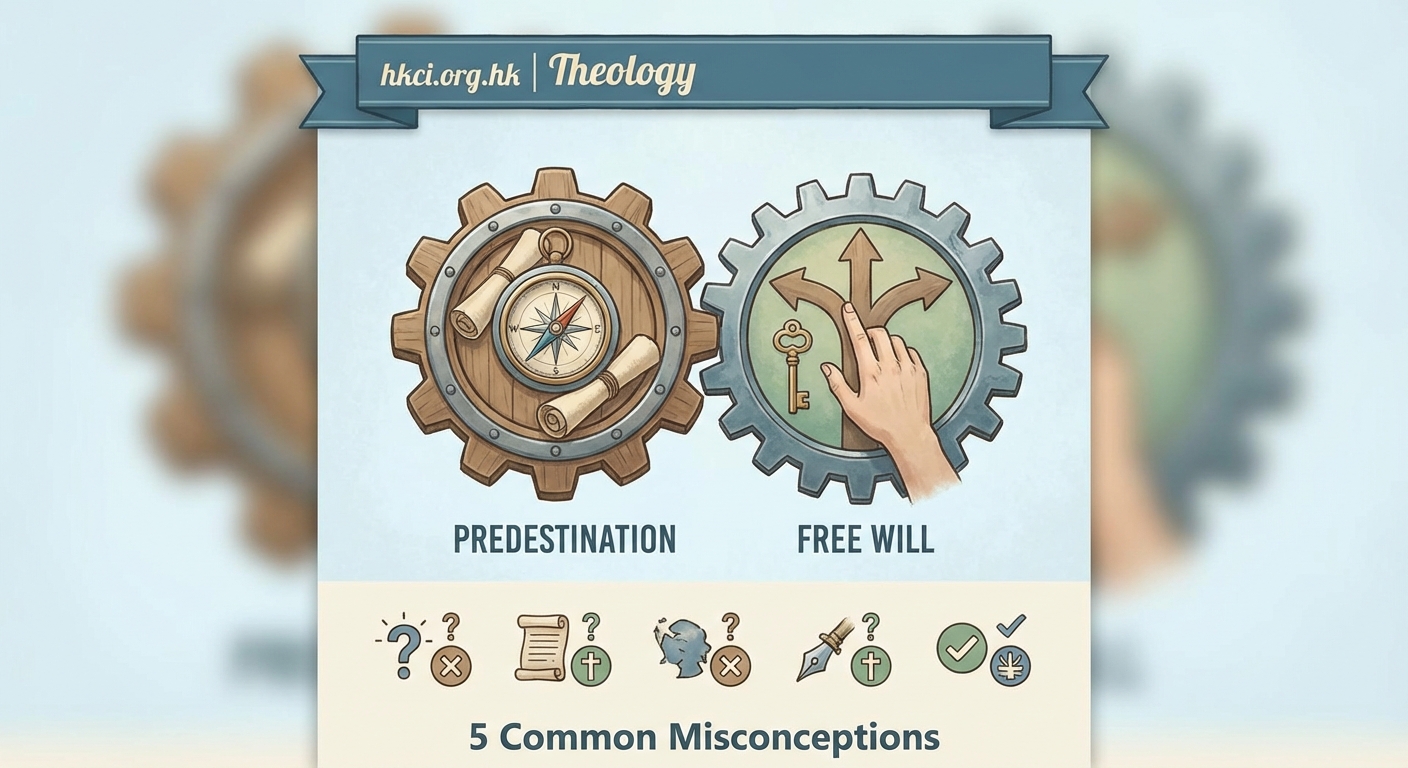
If God has already chosen who will be saved, why share the gospel at all? This objection sounds logical on the surface but misunderstands how God’s purposes work.
God ordains both the ends and the means. He doesn’t just decide who will be saved. He also determines how they will be saved.
Romans 10:14-15 makes this clear: “How then will they call on him in whom they have not believed? And how are they to believe in him of whom they have never heard? And how are they to hear without someone preaching?”
God has chosen to save people through the proclamation of the gospel. Evangelism is not plan B. It’s God’s appointed method.
The most evangelistic Christians in history have often been those who held firmly to predestination. Consider these examples:
- George Whitefield preached to thousands across America and England
- William Carey launched the modern missions movement
- Charles Spurgeon saw countless conversions through his preaching
All three held strong views on divine election. Their belief in God’s sovereignty didn’t diminish their evangelistic zeal. It fueled it.
Why? Because they knew their efforts wouldn’t return void. God had people he was calling, and he would use their faithful preaching to reach them.
Predestination actually provides confidence in evangelism. You’re not trying to manufacture conversions through clever techniques. You’re planting and watering, trusting God to give the growth.
Misconception three: free will means autonomous choice
On the other side of the debate, many assume that defending human freedom requires absolute autonomy. They picture the will as completely independent from God’s influence.
This view creates its own problems. If our wills are truly autonomous, God cannot guarantee any outcome. Prayer becomes uncertain. Providence becomes impossible. God’s promises become conditional on human cooperation.
But Scripture presents a different picture of human freedom. We make real choices, but those choices always occur within the context of our nature and desires.
Jesus explains in John 8:34 that “everyone who practices sin is a slave to sin.” Paul describes unbelievers as “dead in trespasses and sins” in Ephesians 2:1. These passages suggest that human freedom is limited by spiritual condition.
Think about it this way. Can you choose to desire something you don’t desire? Can you will yourself to want something you find repulsive?
Your choices flow from your nature. A cat doesn’t choose to bark. A fish doesn’t choose to climb trees. They act according to their nature.
Before regeneration, humans are spiritually dead. We have the natural ability to choose, but not the moral ability to choose God. Our wills are free in one sense but enslaved in another.
This is why Jesus says in John 6:44, “No one can come to me unless the Father who sent me draws him.” The drawing comes first. Then the coming becomes possible.
God doesn’t violate the will. He transforms it. He changes hearts of stone into hearts of flesh. He opens blind eyes. He unstops deaf ears.
After this transformation, people freely choose Christ. But that freedom is a gift, not an inherent capacity.
Misconception four: predestination is unfair
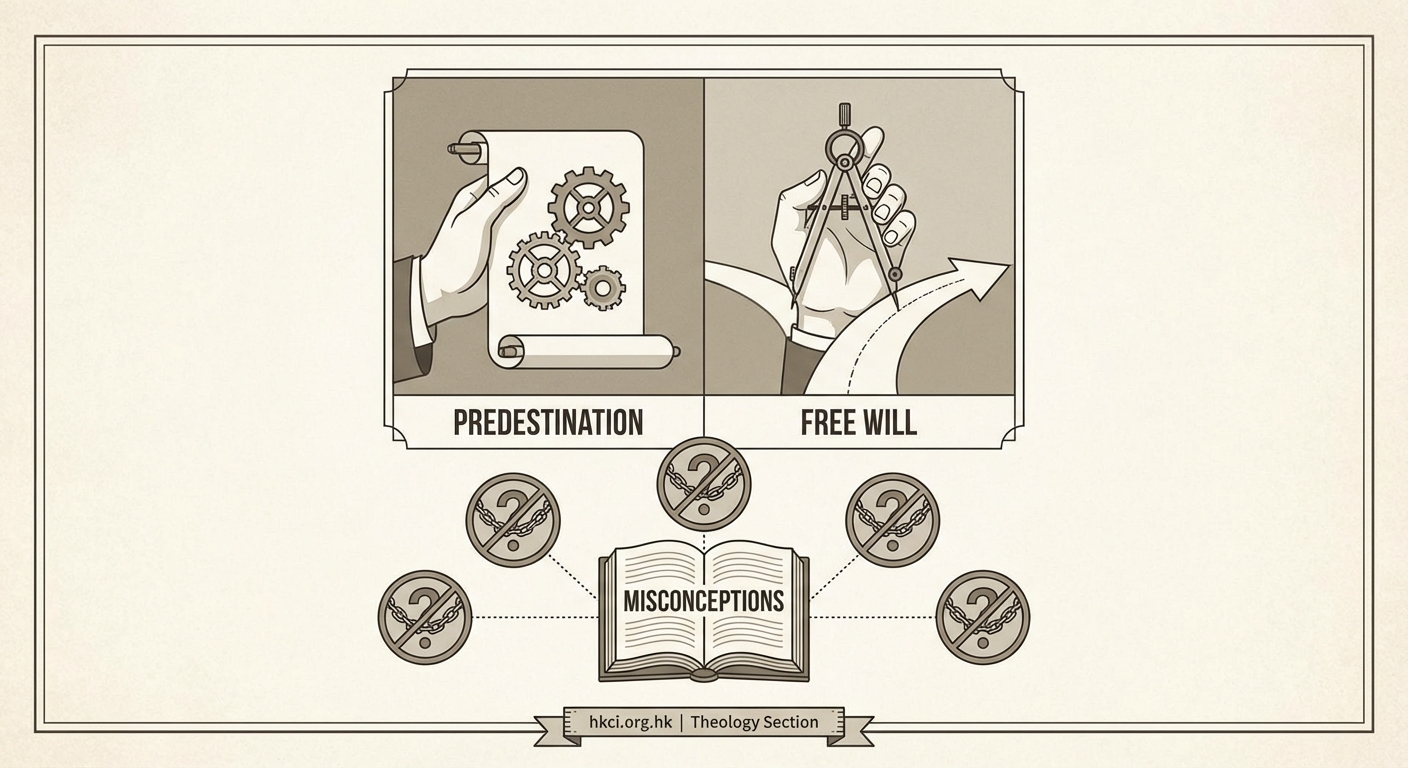
The justice objection runs deep. If God chooses some and passes over others, doesn’t that make him unjust? Doesn’t everyone deserve an equal chance?
Paul anticipates this exact objection in Romans 9:14. He asks, “Is there injustice on God’s part?” His answer is emphatic: “By no means!”
His explanation centers on several key points. First, God owes salvation to no one. If justice were the only consideration, all humanity would be condemned. “All have sinned and fall short of the glory of God.”
Mercy, by definition, is not owed. If God were obligated to show mercy, it wouldn’t be mercy anymore. It would be justice.
Second, God has the right as Creator to do with his creation as he pleases. Paul uses the potter and clay analogy. The potter has authority over the clay.
This doesn’t mean God is arbitrary or capricious. It means he operates by his own counsel, not by standards imposed from outside.
Third, God’s purposes in election display both his mercy and his justice. Some vessels are prepared for wrath, showing his justice. Others are prepared for mercy, showing his grace.
Both attributes are on display. Neither is compromised.
Here’s a helpful comparison table:
| Human perspective | Biblical perspective |
|---|---|
| Everyone deserves a chance | Everyone deserves condemnation |
| God must be fair to all | God shows mercy to some |
| Election is arbitrary | Election displays God’s purposes |
| Passing over some is unjust | Saving any is gracious |
| God owes salvation | God owes nothing but judgment |
The fairness objection often assumes that humans are basically good and deserve God’s favor. Scripture teaches the opposite. We are rebels who deserve judgment.
That God saves anyone is the wonder. That he doesn’t save everyone is not injustice. It’s mercy withheld, not justice denied.
Misconception five: these doctrines don’t matter practically
Some Christians dismiss these debates as irrelevant theological hairsplitting. They argue that predestination and free will are mysteries we should just accept without examination.
This attitude misses how deeply these doctrines shape Christian life and practice.
Your view of these issues affects:
- How you pray for unbelievers
- How you understand your own conversion
- How you view assurance of salvation
- How you respond to suffering
- How you engage in spiritual warfare
If you believe God is sovereign over salvation, you’ll pray with confidence that he can save the hardest heart. You won’t view anyone as beyond hope.
If you understand that your salvation was entirely God’s work, you’ll have a deeper sense of gratitude and security. You won’t wonder if you did enough to earn or keep your salvation.
If you recognize that God works all things according to his purposes, you’ll find comfort in trials. You’ll trust that nothing happens outside his control.
The doctrines of grace are not abstract theories. They are the foundation of Christian assurance, humility, and hope. They protect us from pride in success and despair in failure. They keep us centered on God’s glory rather than human achievement.
Consider how these beliefs practically work out:
- In evangelism: You share boldly, knowing God will save his people
- In suffering: You trust God’s purposes even when you don’t understand
- In prayer: You ask confidently, knowing God controls outcomes
- In sanctification: You work hard while depending on God’s power
- In worship: You give God all glory for your salvation
These aren’t just academic questions. They touch every aspect of Christian life.
The person who grasps God’s sovereignty worships differently. They pray differently. They suffer differently. They serve differently.
How divine sovereignty and human choice work together
The relationship between God’s control and human responsibility remains mysterious. We cannot fully comprehend how both operate simultaneously.
But we can accept what Scripture clearly teaches. Both are true. Both are important. Both must be affirmed.
Think of it like light. Physicists describe light as both a wave and a particle. These seem contradictory, but both are true. Light behaves like a wave in some contexts and like a particle in others.
We don’t reject one truth because we can’t explain how both work together. We accept both based on the evidence.
The same applies here. We may not understand the mechanics, but we can trust the testimony of Scripture.
God is absolutely sovereign. Nothing happens outside his control or against his will. He works all things according to the counsel of his will.
Humans are genuinely responsible. We make real choices. We bear accountability for those choices. We cannot blame God for our sin.
Both truths magnify God. His sovereignty shows his power and authority. Human responsibility shows his justice and righteousness.
Together, they display the fullness of his character. Remove either one, and you diminish God.
The challenge is holding both truths in tension without collapsing one into the other. This requires humility. It requires accepting that God’s ways are higher than our ways.
It means resisting the urge to resolve every tension or answer every question. Some mysteries remain mysteries this side of eternity.
But the practical implications are clear. Trust God’s sovereignty. Take responsibility for your choices. Share the gospel boldly. Work out your salvation with fear and trembling.
Where theology meets daily trust
Understanding these concepts correctly changes how you live as a Christian. It’s not about winning arguments or proving theological points.
When you grasp that God sovereignly chose you before the foundation of the world, gratitude becomes your default posture. Pride has no place. You did nothing to earn this.
When you recognize that your choices matter and your obedience counts, passivity loses its appeal. You can’t coast on God’s sovereignty. You must work, pray, and fight sin.
These truths should drive you to your knees in worship and send you out into the world with confidence. God has a people he is calling. He will complete what he started. Your labor is not in vain.
The doctrines of predestination and free will are not obstacles to faith. They are fuel for faith. They remind you that salvation belongs to the Lord from start to finish, and that your response to his grace matters eternally.