
The first Christians faced a monumental task. They had to define what they believed about God, Jesus, and salvation without a complete New Testament or centuries of theological tradition to guide them. These debates weren’t academic exercises. They determined who was in and who was out, which books belonged in Scripture, and how Christians would worship for millennia to come.
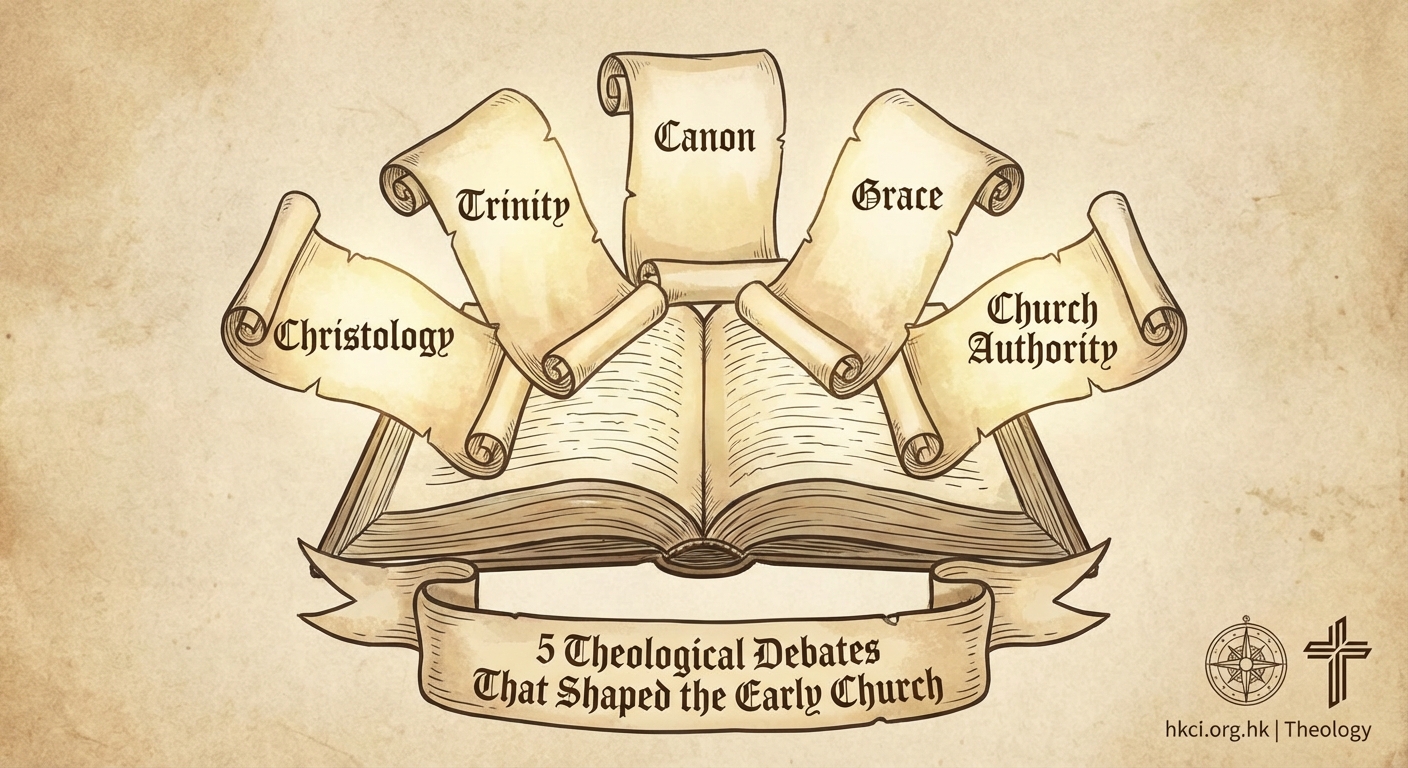
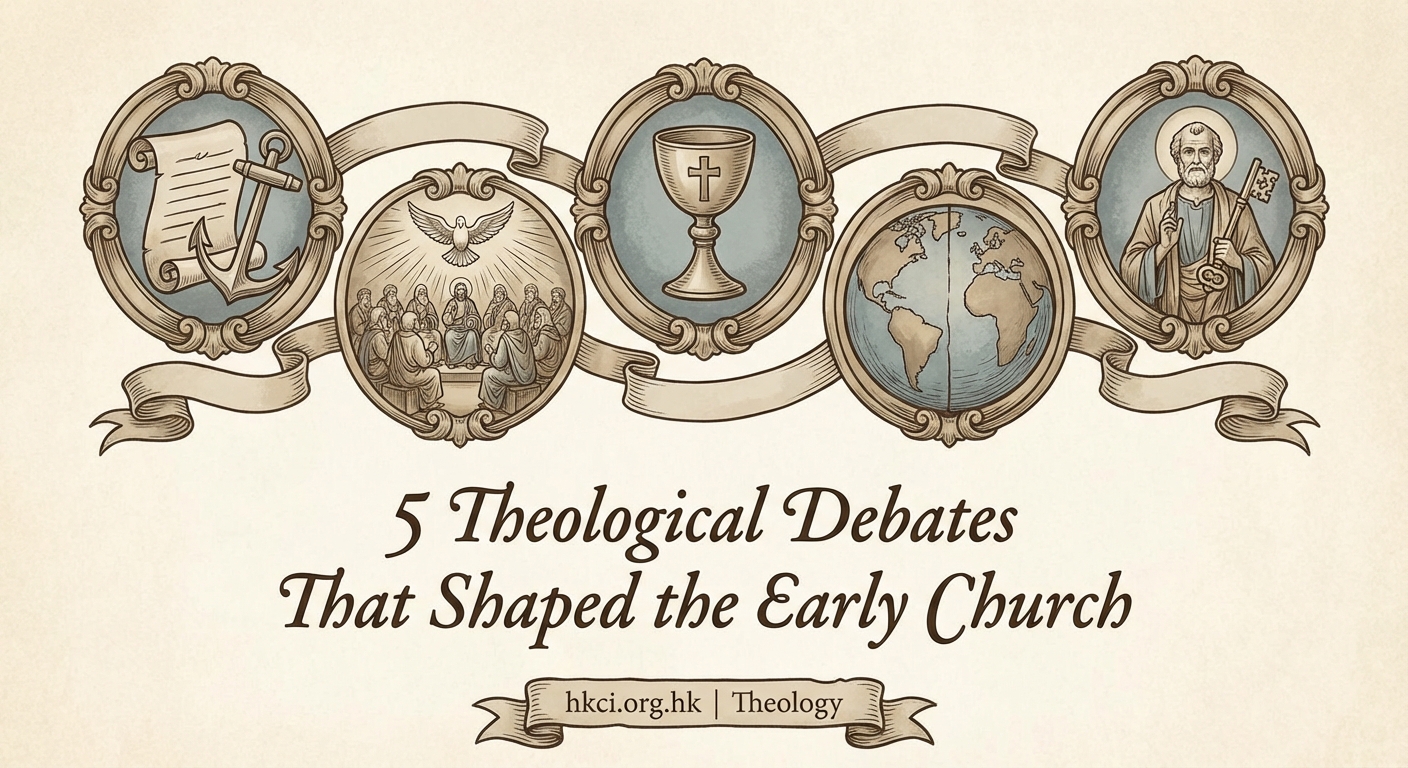
The early church engaged in five pivotal theological debates that shaped Christianity: the nature of the Trinity, the divinity and humanity of Christ, the formation of the biblical canon, the relationship between grace and works, and the role of church authority. These controversies, resolved through councils and creeds between the second and fifth centuries, established the doctrinal foundations that most Christian denominations still affirm today.
The Trinity debate: One God or three?
The Trinity stands as Christianity’s most distinctive and puzzling doctrine. But for the first three centuries, Christians argued intensely about how to describe God.
Arius, a presbyter in Alexandria around 320 AD, taught that Jesus was the first and greatest creation of God the Father. This made sense to many believers. After all, the Bible calls Jesus the “firstborn” and records him praying to the Father. If Jesus prayed to God, weren’t they separate beings with different levels of power?
The problem ran deeper than semantics. If Jesus wasn’t fully God, could his death actually save humanity? Could a created being bridge the gap between infinite God and finite humans?
Bishop Alexander of Alexandria opposed Arius fiercely. He argued that Jesus had always existed as God, co-equal and co-eternal with the Father. The debate split churches across the Roman Empire.
Emperor Constantine called the Council of Nicaea in 325 AD to settle the matter. Over 300 bishops gathered and produced the Nicene Creed, which declared Jesus “begotten, not made, of one substance with the Father.” Arius lost.
But the controversy didn’t end there. Arianism persisted for decades, especially among Gothic tribes. The debate forced Christians to develop precise theological language about substance, persons, and essence. These terms still define orthodox Christianity.
“The Council of Nicaea didn’t invent the Trinity. It clarified what Christians had believed from the beginning: that Jesus shares the same divine nature as the Father, making salvation possible through God himself entering human history.”
Christ’s nature: Fully God, fully human, or something else?
Once the church affirmed Jesus as divine, a new question emerged. How could one person be both fully God and fully human at the same time?
Several competing views arose:
- Docetism claimed Jesus only appeared human but was actually pure spirit
- Apollinarianism taught Jesus had a human body but a divine mind
- Nestorianism separated Jesus into two distinct persons, one divine and one human
- Eutychianism blended Jesus’s natures into a single hybrid nature
Each solution created new problems. If Jesus wasn’t truly human, he couldn’t represent humanity in his death. If he wasn’t truly God, his sacrifice lacked infinite value. If his natures were separated or blended, the incarnation became incoherent.
The Council of Chalcedon in 451 AD produced a careful formula. Jesus Christ exists as one person with two complete natures, divine and human, united without confusion, change, division, or separation.
This definition satisfied most Christians, though it split the church. Oriental Orthodox churches rejected Chalcedon, creating a division that persists today.
The debate mattered for practical reasons. Christians needed to know: When Jesus suffered, did God suffer? When Jesus learned, did God learn? When Jesus died, did God die? Chalcedon provided answers that preserved both Jesus’s genuine humanity and his full divinity.
The canon controversy: Which books belong in the Bible?
Early Christians inherited the Hebrew Scriptures but wrote their own texts about Jesus. By the second century, dozens of gospels, letters, and apocalypses circulated among churches. Which ones carried apostolic authority?
The process of forming the New Testament canon took centuries and involved several factors:
- Apostolic origin: Did an apostle or close associate write it?
- Universal acceptance: Did churches across regions use it in worship?
- Theological consistency: Did it align with the rule of faith?
- Spiritual power: Did it edify believers and transform lives?
Some books gained acceptance quickly. The four Gospels, Acts, and Paul’s major letters were widely recognized by 150 AD. Other books remained disputed. Hebrews, James, 2 Peter, 2 and 3 John, Jude, and Revelation faced questions about authorship or theology.
Meanwhile, texts like the Shepherd of Hermas, the Didache, and 1 Clement enjoyed popularity in some regions but ultimately didn’t make the final cut.
Bishop Athanasius of Alexandria provided the first complete list matching our current New Testament in his Easter letter of 367 AD. Church councils in Hippo (393 AD) and Carthage (397 AD) affirmed this canon.
The debate wasn’t arbitrary. Gnostic texts like the Gospel of Thomas presented a different Jesus who offered secret knowledge rather than salvation through his death and resurrection. The church had to distinguish apostolic witness from later innovations.
| Accepted Early | Disputed | Eventually Rejected |
|---|---|---|
| Four Gospels | Hebrews | Gospel of Thomas |
| Acts | James | Gospel of Peter |
| Paul’s letters | 2 Peter | Shepherd of Hermas |
| 1 John | 2-3 John | Epistle of Barnabas |
| 1 Peter | Jude | Didache |
| Revelation | 1 Clement |
Grace versus works: How are people saved?
The relationship between divine grace and human effort sparked controversy from the beginning. Paul’s letters emphasize salvation by grace through faith, not works. But James insists that faith without works is dead. How do these fit together?
Pelagius, a British monk active around 400 AD, stressed human moral capacity. He taught that people could choose to obey God perfectly without divine grace. Sin was merely bad example, not an inherited condition. Salvation required personal effort and moral improvement.
Augustine of Hippo opposed this view with passion. He argued that Adam’s sin corrupted all humanity. People were born spiritually dead, unable to choose God without his grace. Salvation was entirely God’s work, from beginning to end. Even faith itself was a gift.
The debate touched raw nerves. If Pelagius was right, why did Jesus need to die? If Augustine was right, why bother trying to live righteously? The controversy raged across North Africa and Europe.
Church councils condemned Pelagianism at Carthage (418 AD) and Ephesus (431 AD). But the questions persisted. How does grace work? Does God choose who will be saved? Can believers lose their salvation? These issues would resurface dramatically during the Protestant Reformation.
The early church settled on a middle position. Salvation comes by grace alone, but grace produces genuine transformation. Faith and works aren’t competing paths to salvation. Faith is the means; works are the evidence. Grace doesn’t eliminate human responsibility but enables it.
Church authority: Who decides doctrine?
As theological disputes multiplied, Christians needed a way to resolve them. Who had the authority to declare official doctrine?
Several competing models emerged:
- Episcopal authority: Bishops in apostolic succession could define truth
- Conciliar authority: Church councils representing all bishops decided together
- Scriptural authority: The Bible alone provided the final standard
- Tradition: Apostolic teaching passed down orally alongside Scripture
The Catholic model emphasized the authority of bishops, especially the Bishop of Rome. The Orthodox model stressed conciliar decisions requiring consensus. Both valued tradition as a guide for interpreting Scripture.
The debates produced a practical solution. Major controversies would be settled by ecumenical councils where bishops gathered, debated Scripture and tradition, and issued binding decisions. The first seven ecumenical councils, from Nicaea (325 AD) to Nicaea II (787 AD), defined orthodox Christianity for both East and West.
But tensions remained. When councils disagreed, who decided which council was legitimate? When bishops taught different doctrines, who determined which was correct? These questions about authority would eventually contribute to the Great Schism between Eastern and Western Christianity in 1054 AD.
The authority debate shaped how Christians read the Bible. Is Scripture self-interpreting, or does it require the church’s guidance? Can individuals understand Scripture correctly, or do they need ordained teachers? These questions remain contentious across denominations today.
How these debates still matter
You might think ancient theological controversies are irrelevant to modern faith. But these debates established the boundaries of Christian orthodoxy.
When you recite the Nicene Creed in church, you’re affirming positions hammered out in heated fourth-century debates. When you read your Bible, you’re trusting decisions made by fifth-century bishops about which books carry apostolic authority. When you think about salvation, you’re navigating questions Augustine and Pelagius argued about sixteen centuries ago.
These weren’t abstract philosophical puzzles. They determined how Christians worship, what they believe about Jesus, and how they understand salvation. The early church fathers weren’t perfect. They sometimes used political power inappropriately and excluded voices that deserved hearing. But they took theology seriously because they knew ideas have consequences.
Modern Christians benefit from their work. We don’t have to reinvent basic doctrines about God’s nature or Christ’s identity. We can build on foundations they laid through careful study of Scripture and reasoned debate.
Understanding these controversies also creates humility. If brilliant, devout Christians disagreed about major doctrines for centuries, perhaps we should approach our own theological certainties with more caution. The early church teaches us that wrestling with difficult questions is part of faithful discipleship.
Why the struggle shaped the faith
The early church’s theological debates weren’t detours from the gospel. They were essential to understanding it. By asking hard questions about God, Jesus, Scripture, salvation, and authority, early Christians clarified what the apostles taught and what the Bible reveals.
These controversies forced believers to think carefully, study Scripture deeply, and articulate their faith precisely. The result was a more robust, intellectually coherent Christianity that could withstand challenges and adapt to new cultures. The creeds and councils didn’t create Christian doctrine. They protected and clarified it for future generations. That legacy continues to guide believers who want to think deeply about their faith and understand the foundations on which it rests.